
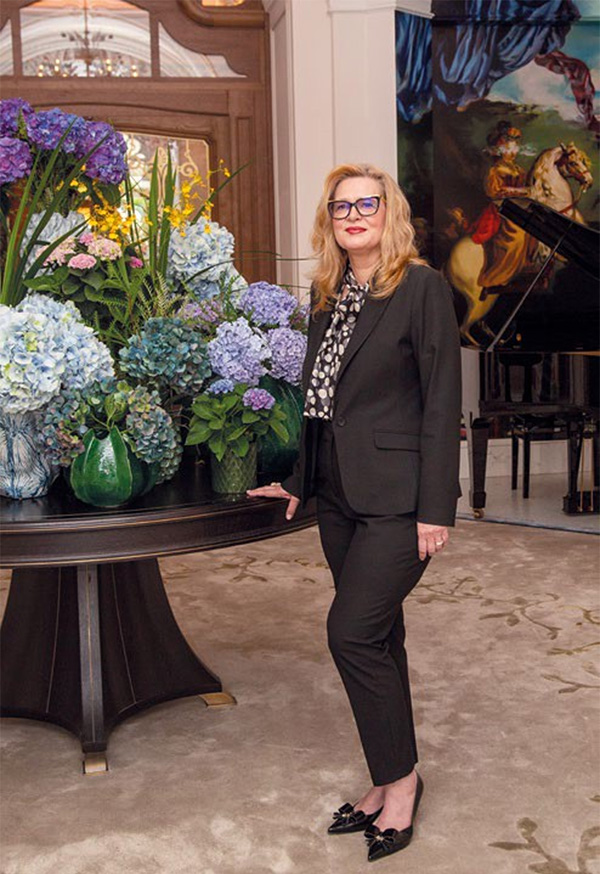
Mihaela Dănilă
In an industry where success is measured by the stability and safe operation of networks, management is conducted on the construction site, not just in the boardroom. For Mihaela Dănilă, Founder and General Manager of Enerconstruct, results emerge at the intersection of technical competence and execution rigor.
With a professional trajectory built on a solid foundation, beginning in 1996 as a graduate of the Faculty of Power Engineering at the Politehnica University of Bucharest, Mihaela Dănilă has built a group of companies that has today become a benchmark of reliability in energy services within the Muntenia region.
In the following interview, she reveals the pragmatic principles that guide her in business and the art of leading complex teams while always maintaining contact with the reality on the ground.
Enerconstruct has established a strong reputation in the B2B energy market by offering an end-to-end service spectrum – from navigating complex documentation and permitting, to the physical construction of power lines and transformer substations. What was the defining moment when you realized that specializing in integrated technical services was the winning strategy?
Mihaela Dănilă: The confirmation came from the field, not from the office. In the energy sector, the barrier to entry is technical, but the barrier to remaining in the market relies on predictability and flawless execution. I started Enerconstruct with the idea of offering a complete workflow of energy services aimed at relieving the beneficiary: we take over the project from the administrative labyrinth – obtaining location and grid connection permits, network construction permits, and agreements from public land administrators – and we carry it through to the actual execution and commissioning of the project. I realized that our model was the winning one when operators and large industrial clients sought us out for projects where downtime was simply out of the question. Whether we are talking about the implementation of indoor electrical installations for complex industrial constructions, power connections, or the execution of power lines and transformer substations and stations, we chose rigor in production. This deliberate positioning has allowed us to grow organically, becoming the partner that transforms investment plans into real infrastructure.
The energy transition is the topic of the moment. From the perspective of a leader who actively manages design and installation teams, how is this transition viewed regarding the distribution infrastructure in Romania?
M.D.: At the operational level, the energy transition is not implemented merely through emails and from consultancy offices. It puts immense pressure on our networks, which already operate under high load levels. As service providers, we are on the front line. The real challenge is not just to be builders or architects of the new energy infrastructure, but to swiftly build new transformer substations and power lines to cope with new energy consumers. Our role is to be the “technical arm” of this change, ensuring that execution is carried out using current technologies, yet firmly anchored in the reality of each site.
You mention the “technical arm,” but the industry is facing an acute labor shortage. How can this critical vulnerability be covered practically, day by day?
M.D.: The weak link is the lack of specialists across the entire workflow. Without certified electricians for power line
s and connections, our network development plans remain nothing more than excellent sustainability reports. The educational void created by the abolition of the old vocational schools has left us without entire generations of electricians and system technicians. In critical services, you need people who know how to execute correctly and safely, and moreover, people capable of subsequently ensuring the maintenance of the completed works. Having investment budgets and permits obtained on time is useless if construction sites risk being blocked by a lack of execution teams.
Data regarding dual education is encouraging – reaching over 9,000 planned spots, although only 77% of these are currently occupied – but it hides a problem: in its current form, dual education risks becoming a tool exclusively accessible to large corporations. An average company (SME), which actually forms the engine of execution in Romania, does not have the financial power to fully equip a school laboratory, nor does it need to absorb 30 employees at once, but rather 2 or 3 specialists per year. The solution I see in this situation is forming associations. SMEs must think of associative platforms, public-private partnerships with schools and local administration, where multiple companies pool their resources to support a class. Thus, we can proactively go into disadvantaged areas to offer a highly paid profession to children who, perhaps, do not have the same conditions as those in economically developed areas, simultaneously solving our operational deficit and a major social problem.
We must lift the stigma surrounding vocational schools: a specialist working in a medium-voltage station is just as valuable as a programmer, and incomes already reflect this. Until then, however, the immediate solution is vocational retraining or upskilling directly at the workplace. But we must be realistic: a specialized contractor is not an apprenticeship school at its own expense. We genuinely mentor people, directly during execution works, consuming precious hours from the working time of our experienced engineers. For this mechanism to work on a large scale, the state must offer real tax incentives to companies that take on the effort of qualifying personnel at the workplace.
This need to attract talent from all directions is also tied to your presence on the Board of Directors of SPER (The Society of Female Energy Professionals in Romania). How important is it for women to take on a larger role in an eminently technical industry?
M.D.: A stronger presence of women in energy is not an image-building endeavor, but a strict business necessity. Energy has long been a predominantly male field, but in service management, in obtaining complex permits, and in execution coordination, women are establishing themselves as architects of new policies and risk management models that save huge budgets. In a talent crisis, it is inefficient not to utilize the entire potential of the market.
Women in energy, many of us with rigorous technical training, bring not just diversity, but pragmatic solutions. That is precisely why, alongside my colleagues from the SPER Association, we aim to transform our expertise into real policies. We draft and advocate for viable legislative proposals to solve the workforce problem, as we are oriented towards concrete measures and efficiency – qualities that the engineering profession has fully cultivated in us.
In a national economic environment often marked by legislative changes and unpredictability, how does Enerconstruct manage to maintain a steady growth rate and ensure stability in such a complex market?
M.D.: The secret lies in evolution and decisional agility. Over time, I understood that I had to integrate the technical precision of an engineer into a strategic business vision. I am no longer just an engineer running a company; I have proven that I am also a manager capable of achieving performance, growing professionally alongside the company I lead. This allows us to transform the strict regulations in Romania – where we operate in a highly regulated environment, absolutely essential when dealing with the “power of electricity,” even though bureaucratic “short circuits” sometimes occur – into genuine guarantees of quality. In our field, legislative changes occur quite frequently, generating uncertainty and additional costs, and implementing environmental policies is a major challenge. However, the main barrier to capital development remains fiscal unpredictability, which generates hidden costs that erode competitiveness. For this reason, to avoid a blind struggle for survival, we rely on a strict policy of efficient financial resource management, keeping the company completely financially independent. The continuous monitoring of cash flow and a high degree of self-financing provide us with the necessary freedom of action to make rapid and safe strategic decisions.
Speaking of this evolution, how is it reflected in the company’s future plans, and what is the foundation of the trust your clients have placed in you for so long?
M.D.: For the upcoming period, we aim to raise the bar in every respect: we are targeting a 20% increase in turnover and a 10% expansion of our team. Our goal remains achieving long-term sustainable profit, the only one capable of building resilience and ensuring the future development of the business. The trust of our clients is based on a solid reciprocal relationship, confirmed by Enerconstruct’s track record and the over 2,000 projects successfully completed during our 25 years of activity.
In an industry where “shortcuts” can be costly, we rely on the stability of long-term partnerships, offering clients the certainty of a company that consistently delivers what it promises. Our strength comes from the fact that we offer not just services, but safety and continuity, daily developing a success story alongside an exceptional team, where we have colleagues who have been with us for 20 years, demonstrating a remarkable retention rate despite the general crisis of skilled personnel.
What is the most valuable leadership principle you apply at Enerconstruct to keep your teams united and efficient?
M.D.: My basic principle is: “Stay close to operations!”. It is a philosophy which states that a leader must understand the technical details and the harsh reality of the people on the field. If you lose contact with the construction site, the decisions you make from the office risk being detached from reality. Our success lies in the fact that the team knows I understand their difficulties in the execution process, whether they are installing an underground cable or a transformer substation. I am not afraid to put on my hard hat and go to the construction site, because authority in this field is earned exclusively through competence and the ability to solve real problems, not through the title on a business card.
