
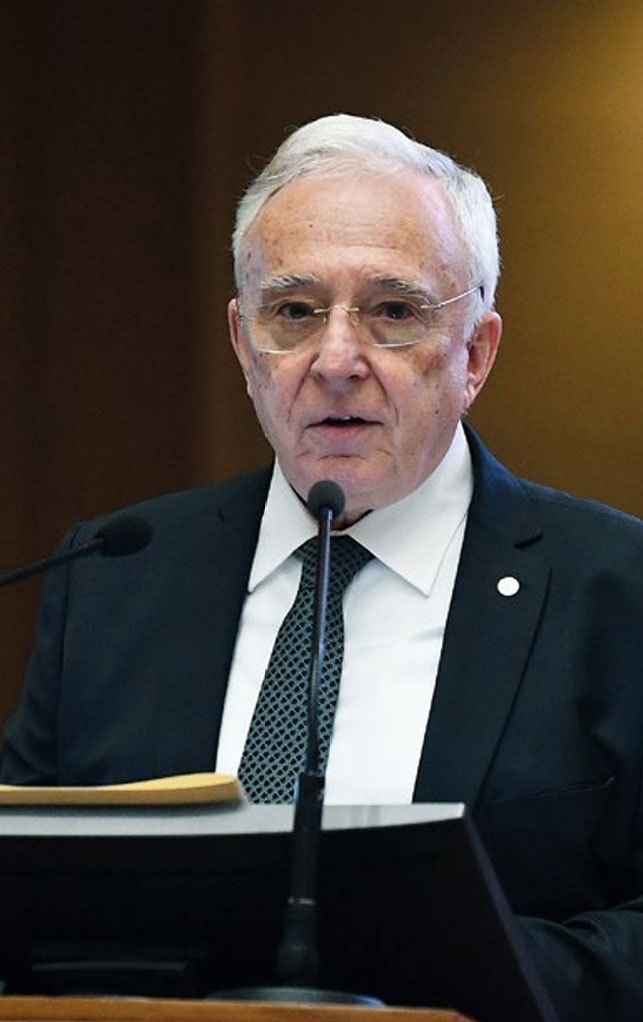
Mugur Isărescu
Governor of the National Bank of Romania
The Man of Stability
Over the past three and a half decades, Romania has experienced very few constants. Governments have changed, global crises have arrived in waves, and society has undergone profound transformations. Throughout this entire period, one name has remained almost permanently associated with the idea of financial stability: Governor Mugur Isărescu. For entire generations of Romanians, the Governor of the National Bank of Romania has become a familiar presence. Many have changed jobs, lived through inflation, loans, currency conversions, and economic crises, yet maintained the sense that somewhere within the imposing headquarters of the National Bank there was continuity. That continuity bears the name Mugur Isărescu. Born on August 1, 1949, in Drăgășani, he belongs to a generation shaped in a Romania vastly different from the 3 one we know today. He graduated from the Bucharest University of Economic Studies, specializing in foreign trade at a time when the Romanian economy operated under the rules of centralized planning. From the very beginning of his career, however, he chose research—a field that allowed him to look beyond the boundaries of the communist economic system. For nearly two decades, he worked as a researcher at the Institute of World Economy. He studied the mechanisms of market economies, international monetary relations, credit systems, and exchange-rate policies. In an era when access to information was limited, this specialization provided him with a rare perspective on how developed economies functioned. In 1989, he earned his PhD in Economics with a dissertation focused on international exchange-rate policies, a subject that would become defining for his entire career. The events of December 1989 changed Romania’s destiny— and that of economist Mugur Isărescu. In the first months of 1990, he was appointed Economic Secretary at the Romanian Embassy in the United States. It was a period during which Romania was attempting to reconnect with international financial institutions and find its place in a global economy that it had observed from a distance for decades. His American experience was brief but formative for his future. In September 1990, only a few months after the fall of the communist regime, Mugur Isărescu was appointed Governor of the National Bank of Romania. At the age of 41, he assumed leadership of an institution that, like the entire Romanian economy, had to be virtually
reinvented. The 1990s were perhaps the most difficult period in the recent history of the Romanian economy. Inflation was rampant, industrial restructuring generated social tensions, and the banking system was fragile and insufficiently regulated. In this context, Isărescu chose a strategy based on prudence and institutional building. He was not a man of spectacular decisions, but rather of gradual and consistent processes. This approach would define his entire career. While the political scene was dominated by confrontation and abrupt changes, the Governor of the National Bank cultivated the image of a technocrat committed to balance and stability. Gradually, he became one of the most influential voices in the Romanian economy and one of the most respected central bankers in Central and Eastern Europe. One of the most important moments of his tenure was the redenomination of the national currency in 2005. For many Romanians, the removal of four zeros from banknotes symbolized the normalization of the economy. The new leu (RON) simplified transactions and sent a strong signal of confidence to both the public and foreign investors. Beyond its technical aspects, the measure marked the end 4 of an era dominated by high inflation and the beginning of a period of monetary stability. At the end of 1999, Mugur Isărescu accepted a different challenge. He became Prime Minister of Romania at a delicate moment when the country was accelerating its efforts toward European integration. His tenure at Victoria Palace lasted only one year, yet it was sufficient to help consolidate Romania’s pro-European direction and prepare key reforms that would later facilitate the country’s accession to the European Union. After returning to the leadership of the National Bank, he continued to promote financial discipline and institutional independence. During the global financial crisis of 2008, when many countries faced major imbalances, Romania experienced one of the most difficult economic periods since the Revolution. The role of the National Bank became crucial. Through prudent policies and careful management of foreign exchange reserves, the Romanian banking system avoided shocks that could have had far more severe consequences. In many respects, Mugur Isărescu’s career is inseparable from the modernization of the National Bank of Romania. Under his leadership, the institution evolved into a modern central bank, connected to major international financial structures and integrated into European mechanisms of monetary supervision and coordination. As a member of the Romanian Academy and an active participant in organizations such as the International Monetary Fund, the World Bank, the Bank for International Settlements, and the European System of Central Banks, Isărescu has consistently represented Romania’s interests in the world’s leading centers of economic decision-making. There is, however, another dimension to his personality. Far removed from figures, reports, and monetary policy meetings, Mugur Isărescu is also known for his passion for viticulture. In Drăgășani, the town where he was born, he developed Casa Isărescu, a project that reflects his connection to local traditions and his native land. In an age dominated by speed and digitalization, this dedication to wine and local heritage seems to reflect the same philosophy of patience that has characterized his professional life. Discreet in his personal life, married and the father of two children, the Governor has always avoided excessive public exposure. He has rarely sought popularity and has almost never cultivated the image of a charismatic politician. His authority has been built differently: through competence, consistency, and credibility.
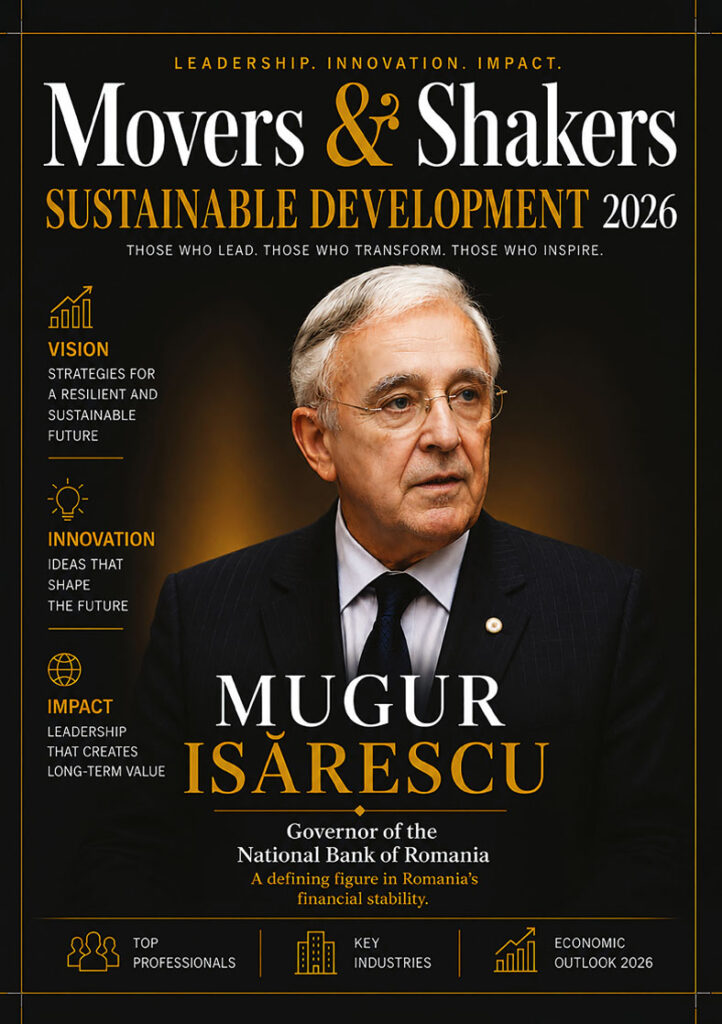
After more than three decades at the helm of the National Bank of Romania, Mugur Isărescu remains one of the longest-serving and most influential public figures in contemporary Romania. Praised by supporters for his professionalism and occasionally criticized for the unprecedented longevity of his tenure, he continues to be widely regarded as the man who has navigated all the major economic transformations of post-communist Romania.
