
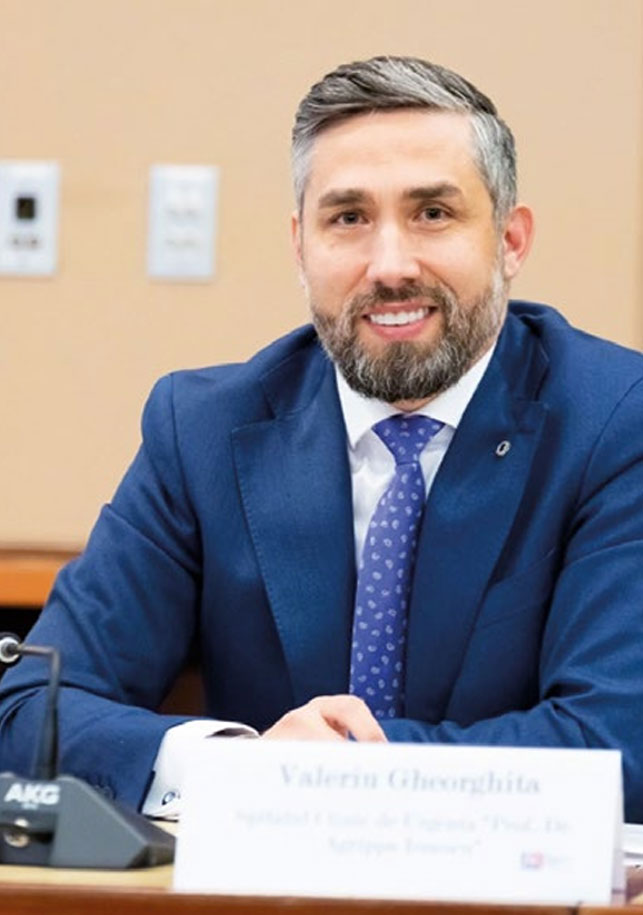
Professor Valeriu Gheorghiță,
MD, PhD
General Director of the “Prof. Dr. Agrippa Ionescu” Clinical
Emergency Hospital
“A physician between science,
public responsibility and
institutional vision”
Professor Valeriu Gheorghiță, MD, PhD, is one of the most visible representatives of contemporary Romanian medicine, a physician whose professional journey has evolved at the intersection of clinical expertise, academic vocation, public health leadership and institutional construction. His career reflects a coherent and demanding understanding of medicine: not only as a field of knowledge and clinical practice, but also as a form of public service, a space of education and a responsibility toward the future of healthcare institutions.
Trained in the rigorous environment of military medical education, Dr Gheorghiță graduated from the Military Faculty of General Medicine at the University of Medicine and Pharmacy of Târgu Mureș in 2006, ranking first among military medical students. This early academic distinction anticipated a professional path marked by discipline, perseverance and a strong sense of duty. He subsequently trained in infectious diseases at the “Prof. Dr. Matei Balș” National Institute of Infectious Diseases, becoming a specialist in 2012 and a senior consultant in 2017.
His academic development has been equally consistent. In 2013, he obtained his PhD in Medical Sciences from the “Carol Davila” University of Medicine and Pharmacy in Bucharest, followed by postdoctoral research dedicated to sepsis and the pathophysiology of neuroendocrine dysfunction. Over the years, he advanced through all competitive university ranks, reaching the position of Professor of Infectious Diseases. Since 2024, he has held habilitation in Medicine, which grants him the right to supervise doctoral research.
For Professor Gheorghiță, academic medicine is not limited to teaching; it is a formative mission, one that requires cultivating critical thinking, intellectual honesty, scientific discipline and the capacity to transform evidence into responsible clinical decisions.
His scientific work mirrors the complexity of infectious diseases in the 21st century. He has authored and co-authored indexed articles, book chapters and specialized medical volumes, and has been invited as a lecturer at numerous national and international scientific meetings. His fields of interest include antimicrobial resistance, healthcare-associated infections, antimicrobial stewardship, HIV infection, viral hepatitis, sepsis, respiratory infections, postoperative infections, vaccination and emerging infectious diseases. This broad scientific portfolio is complemented by his involvement in clinical studies and by an openness to interdisciplinary innovation, reflected also in the co-authorship of an invention patent in 2023.
A defining chapter in his public career began in November 2020, when he was appointed President of the National Committee for the Coordination of Activities on COVID-19 Vaccination. In this role, he coordinated Romania’s national vaccination campaign during one of the most complex public health crises in recent history. The task required more than medical knowledge. It demanded strategic judgment, institutional coordination, public communication and the ability to act under the pressure of uncertainty. In a period marked by scientific urgency, social anxiety and intense public scrutiny, his work emphasized the importance of evidence-based decisions, transparent communication and trust between medical institutions and society.
Beyond that exceptional moment, one of the most consistent directions of his career has been the fight against antimicrobial resistance and healthcare associated infections. These are among the most pressing challenges of modern medicine, threatening the safety of patients, the effectiveness of medical interventions and the resilience of healthcare systems. Dr Gheorghiță has approached this field not only as a clinician and researcher, but also as an institutional leader. His work has supported the development of antibiotic stewardship, infection prevention and control, professional education and the translation of scientific evidence into hospital practice. In his view, progress in this area requires more than isolated measures; it requires systems capable of learning, adapting and sustaining change.
This scientific direction has recently been strengthened by the publication, together with an extended group of Romanian authors, of the article “Emergence of ST383 carbapenem-resistant Klebsiella pneumoniae harboring blaNDM-5 and blaOXA-48 carbapenemase genes in a Romanian tertiary-care hospital”, published in JAC Antimicrobial Resistance in 2026. The study documents the emergence of ST383 as a dominant carbapenemase producing lineage of Klebsiella pneumoniae and reports the first documented identification in Romania of strains co-harboring blaNDM-5 and blaOXA-48 carbapenemase genes. In a country facing a substantial burden of carbapenem resistance, this work is highly relevant.

It underlines the need for genomic surveillance, rapid microbiological diagnosis, robust infection control and integrated antimicrobial stewardship as essential tools for protecting patients and limiting the spread of high risk multidrug-resistant clones.
In March 2022, Professor Gheorghiță assumed the position of General Director of the “Prof. Dr. Agrippa Ionescu” Clinical Emergency Hospital. This appointment opened a new stage in his professional trajectory, bringing together his clinical, academic and public health experience within a broader institutional mission. Under his leadership, the hospital has entered a process of consolidation and development, with an emphasis on expanding clinical capacity, strengthening multidisciplinary care, supporting academic activity and creating the premises for a more competitive research environment.
His managerial vision is built around the idea of the modern university hospital as a living ecosystem. In such an institution, patient care, education, research, digitalization, quality improvement and professional development cannot function separately. They must reinforce one another. This perspective places the hospital not only as a provider of medical services, but also as a generator of knowledge, a training environment for future professionals and a platform for innovation. In this sense, he promotes a model of leadership grounded in continuity, institutional culture and long-term value.
A central objective of his mandate is the development of medical research within the hospital environment. He supports the consolidation of clinical trial platforms, participation in national and international scientific networks and the creation of a professional culture in which research becomes an integral part of clinical excellence. This approach is particularly important in fields such as infectious diseases, antimicrobial resistance and healthcare-associated infections, where rapid access to data, interdisciplinary collaboration and institutional learning can directly influence patient outcomes.
The same vision is reflected in the project of the Integrated Medical Campus located in Balotești, Ilfov county, representing one of the major initiatives associated with the next stage of institutional development. Conceived as a comprehensive clinical, academic and research ecosystem, the campus aims to bring together a modern hospital, integrated outpatient services, palliative care, medical education, research infrastructure and extended services for patients. Its purpose is not merely architectural or administrative. It proposes a model of healthcare organization in which the patient remains at the center, while medical practice is connected to science, education, innovation and continuity of care.
In a healthcare system often challenged by fragmentation, limited resources and the need for structural reform, such a project expresses a broader institutional ambition: to create a medical environment capable of generating performance, attracting professionals, supporting research and offering patients access to high-quality services.
At the core of this trajectory lies a constant principle: medicine must be practiced with rigor, communicated with responsibility and organized with vision. Whether standing before a patient, a student, a research team, a public audience, or a hospital institution, Professor Gheorghiță’s professional journey reflects the same enduring commitment to science, service, and lasting institutional development.
In a medical landscape shaped by antimicrobial resistance, emerging infections, technological transformation and increasing expectations from society, his career illustrates the kind of leadership needed for the future: scientifically grounded, ethically responsible, institutionally coherent and oriented toward continuity. Through his work, Professor Valeriu Gheorghiță contributes not only to the field of infectious diseases, but also to the broader modernization of Romanian medicine
