
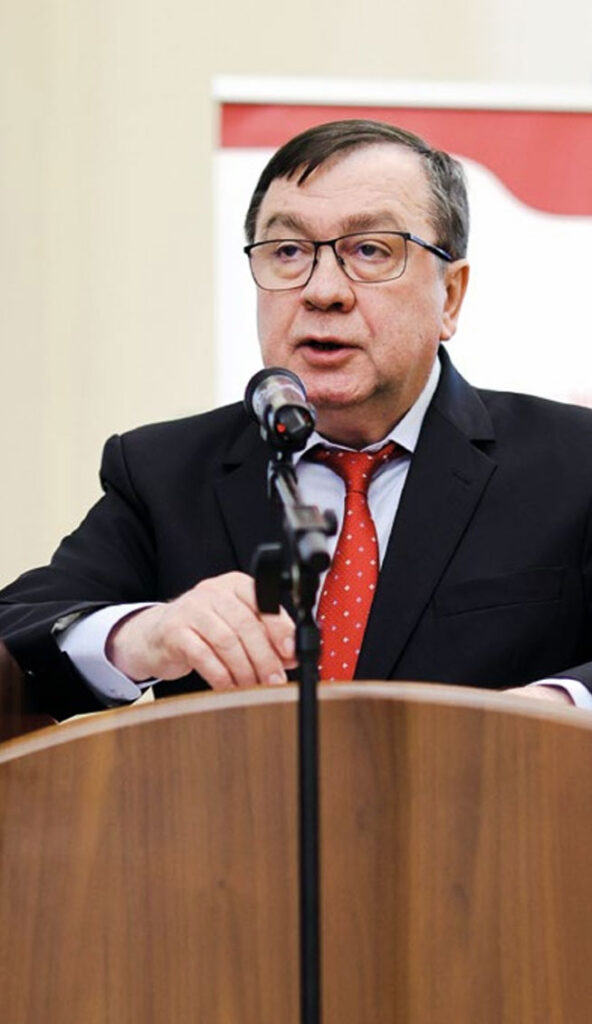
Prof. Viorel Jinga, MD, PhD
Rector of “Carol Davila” University of Medicine and Pharmacy,
Bucharest
Building hospitals and modernizing healthcare infrastructure are necessary, but they are not sufficient to improve the population’s health. This is the central message conveyed by Professor Viorel Jinga, MD, PhD, Rector of the “Carol Davila” University of Medicine and Pharmacy in Bucharest, who advocates for a paradigm shift: health must be treated as critical national infrastructure, and the primary objective of the next decade should be to increase the number of healthy life years for Romanians.
According to Viorel Jinga, the experiences of recent years have demonstrated that healthcare cannot be viewed merely as an administrative sector or a budget expenditure category.
“Health is critical national infrastructure,” the Rector argues, emphasizing that the functioning of the economy, the resilience of communities, and citizens’ trust in the state all depend directly on the healthcare system’s ability to prevent and effectively treat disease.
In this context, he proposes changing the question that often dominates public debate. Rather than asking simply, “How much does healthcare cost?”, society should be asking, “What is the cost of diseases that are not treated in time?” Delayed diagnoses, insufficient prevention, and poor coordination of healthcare services generate enormous costs—not only for the healthcare system itself but also for the economy and society as a whole.
In the UMF „Carol Davila” Rector’s view, the performance of the healthcare system should not be measured solely by the number of hospitals built or services delivered, but by its impact on the health of the population.
“The real challenge of the next decade is not merely to build new hospitals, but to gain healthy years of life for Romanians,” says Viorel Jinga.
Achieving this goal requires shifting the focus from treating disease to prevention and early intervention.
In a country that continues to face high mortality rates from cardiovascular diseases, cancer, and other chronic conditions, investments in prevention can have the greatest impact on public health.
Prevention, therefore, must not remain a theoretical chapter in healthcare strategies; it must become a genuine state priority.
Screening programs, health education, vaccination, and early intervention services must be widely accessible and actively utilized.
According to Jinga, an intelligent healthcare system does not wait for disease to appear and worsen; it acts before patients reach advanced stages, when treatment becomes more difficult, more expensive, and less effective.
Prevention not only reduces mortality but also alleviates pressure on hospitals and lowers the long-term costs of the healthcare system.
Professor Viorel Jinga also believes that another factor contributing to the inefficiency of Romania’s healthcare system is the fragmentation of medical care. Patients suffering from chronic illnesses are often forced to navigate a complex path between multiple healthcare providers.
To address this issue, he advocates the development of integrated and functional care pathways that ensure continuity of care and long-term patient monitoring.
Such an approach would reduce delays in diagnosis and treatment, limit complications, and contribute to a more efficient use of available resources.
Equally important, he emphasizes investment in people and access to innovation. Dr. Jinga warns that no healthcare reform can succeed without substantial investment in human resources. Burnout, professional migration, and shortages of medical personnel in certain regions remain major challenges for Romania’s healthcare system.
For this reason, investments must target not only infrastructure and technology, but also professional training, research, and the creation of working conditions that encourage specialists to remain in the country.
At the same time, the Rector considers it essential to expand equitable access to innovation, ensuring that the benefits of medical progress reach as many patients as possible, regardless of the region where they live.
To turn these objectives into reality, the Rector of the “Carol Davila” University of Medicine and Pharmacy proposes a National Pact for Healthy Years of Life, built around several clear priorities: Reducing late diagnoses in major chronic diseases, expanding screening and prevention programs, developing integrated patient care pathways, implementing genuine digitalization of the healthcare system, investing in human resources, expanding access to innovation and integrating mental health into public policies.
In his view, such a project must transcend electoral logic and provide long-term predictability.
“Healthcare cannot be reinvented every four years. Patients do not have time for instability. Physicians do not need constant changes in direction. Investments cannot be planned without predictability,” he argues.
Viorel Jinga also believes that patients must play an active role in shaping healthcare policies. They understand better than anyone the bottlenecks within the system and the impact of administrative delays or limited access to medical services.
For this reason, patient organizations should participate in defining priorities and evaluating the outcomes of public healthcare policies.
