

Interview with
Camelia Botezatu,
Founder & President of Emblematic Romania
As Founder & President of Emblematic Romania, Camelia Botezatu has consistently promoted initiatives that bring together education, research, culture, innovation and sustainable development. Through projects such as LaserMind, developed in partnership with ELI-NP, she advocates a long-term vision in which knowledge, collaboration and resilience become strategic drivers of national competitiveness. In this interview, she reflects on the importance of connecting Romania’s strengths, investing in future generations and building a credible national reputation through performance and meaningful impact.
Over the past years, you have been involved in projects that bring together education, culture, research, sustainable development and resilience. What is the common idea behind them?
Camelia Botezatu: We live in an era defined by constant transformation. Technology is evolving rapidly, economic models are shifting and societies are facing increasingly complex challenges. In such an environment, a country’s greatest strength is its ability to adapt.
Resilience is not simply the ability to withstand difficulties. It is the ability to turn knowledge, talent, experience and institutional capacity into opportunities for growth.
Romania possesses remarkable assets: talented people, scientific expertise, cultural heritage and entrepreneurial energy. The real challenge is to align these strengths around shared objectives and transform potential into lasting impact. This belief has shaped both my professional journey and the vision behind Emblematic Romania.
How would you define Emblematic Romania today?
C B: Emblematic Romania was created as a platform that encourages collaboration across sectors that rarely interact enough.
Education, research, culture, business and local communities all contribute to the country’s progress, yet they often operate independently. Our mission is to create opportunities for dialogue, partnership and joint initiatives capable of generating meaningful results.
Ultimately, Emblematic Romania seeks to highlight Romania’s strengths and support a shared vision for the country’s future.
Why is education one of Emblematic Romania’s priorities?
C B: Because the future is built through education. In the years ahead, competitiveness will increasingly depend on skills, creativity and the ability to learn continuously.
Young people need more than information. They need access to models of excellence and experiences that inspire them. Education must prepare them for a rapidly changing world and give them the confidence to help shape it.
Did this vision inspire the National LaserMind Program?
C B: Absolutely. LaserMind is one of the projects that best illustrates our approach.
Developed together with the National Institute for Research and Development in Physics and Nuclear Engineering “Horia Hulubei” and ELI-NP, the program aims to bring students closer to science, technology and advanced research.
At its core lies a simple question: how can Romania’s scientific achievements become a source of inspiration and opportunity for young people?
Why did you choose ELI-NP and laser research as the foundation of the project?
C B: Because ELI-NP represents one of the most significant achievements of contemporary Romanian science. At Măgurele, Romania hosts one of the world’s most advanced laser research infrastructures.
It is proof that our country can contribute to scientific projects at the highest international level. I believe young people should be aware of these achievements and understand that world-class research is not something that happens elsewhere—it is happening here.
A pilot implementation protocol was recently signed in Vâlcea County. What does this milestone represent?
C B: It is the first step in a model that we believe has national potential.
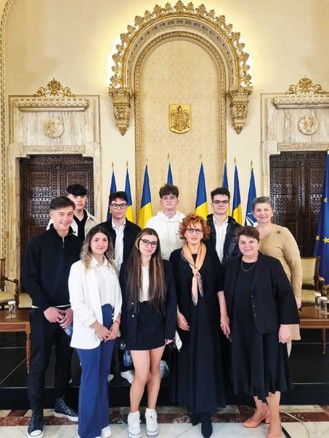
The pilot project brings together schools, local authorities, researchers and institutional partners around a common objective: identifying and supporting young people with an interest and aptitude for physics, science and research, helping them continue their academic journey within Romanian universities and, eventually, in leading fields of innovation and research.
Achieving this goal requires modern educational infrastructure, including high-performance laboratories that provide students with practical experience and access to advanced learning environments. At the same time, the pilot allows us to test and refine a model that can later be replicated across the country.
How does this approach relate to sustainable development?
C B: Sustainable development is, essentially, the ability to build for the long term and make decisions that create value not only for the present, but also for future generations. Education, research, innovation, culture and economic development are not separate processes. They are part of the same construction and should be approached in an integrated manner.
Building sustainably means building responsibly for the future.
How do you see the relationship between sustainable development and a country’s reputation?
C B: Sustainable development and national reputation are
closely connected.
The quality of education, the relevance of research, economic competitiveness, cultural vitality and innovation all influence how a country is perceived internationally. Reputation grows from consistent achievements and from the ability to create value over time.
In this sense, development is not only an economic objective; it is also a source of credibility.
Emblematic Romania is often associated with the concept of nation branding. How do you define it?
C B: Nation branding is the process of expressing a country’s identity in a clear, authentic and credible way.
A strong national brand emerges when there is coherence between what a country represents and what it delivers through its people, institutions and achievements.
Romania already has many compelling stories to tell. The challenge is to bring them together into a narrative that reflects who we are today and where we want to go tomorrow.
What role does academia play in this vision?
C B: It is an honor for us that Emblematic Romania develops under the auspices of the Romanian Academy. This provides the project with an important intellectual and cultural anchor. Our dialogue with representatives of academia, research institutions and the Romanian Academy has reinforced the belief that education, culture and research must be regarded as strategic resources for Romania’s future. High- performing societies are built on knowledge.
If you were to describe the Romania you would like to leave to future generations, what would it look like?
C B: I would like to see a Romania that understands its strengths and invests confidently in education, research, culture and people.
A country that creates opportunities, rewards excellence and transforms knowledge into progress. A country respected not only for its potential, but for its ability to turn that potential into lasting value.
This is also the mission of Emblematic Romania: to help mobilize Romania’s strengths and contribute to a credible and representative image of the country’s future.
I believe the Romania of tomorrow will be defined not only by the assets it possesses, but by its capacity to bring them together around a common purpose.
