
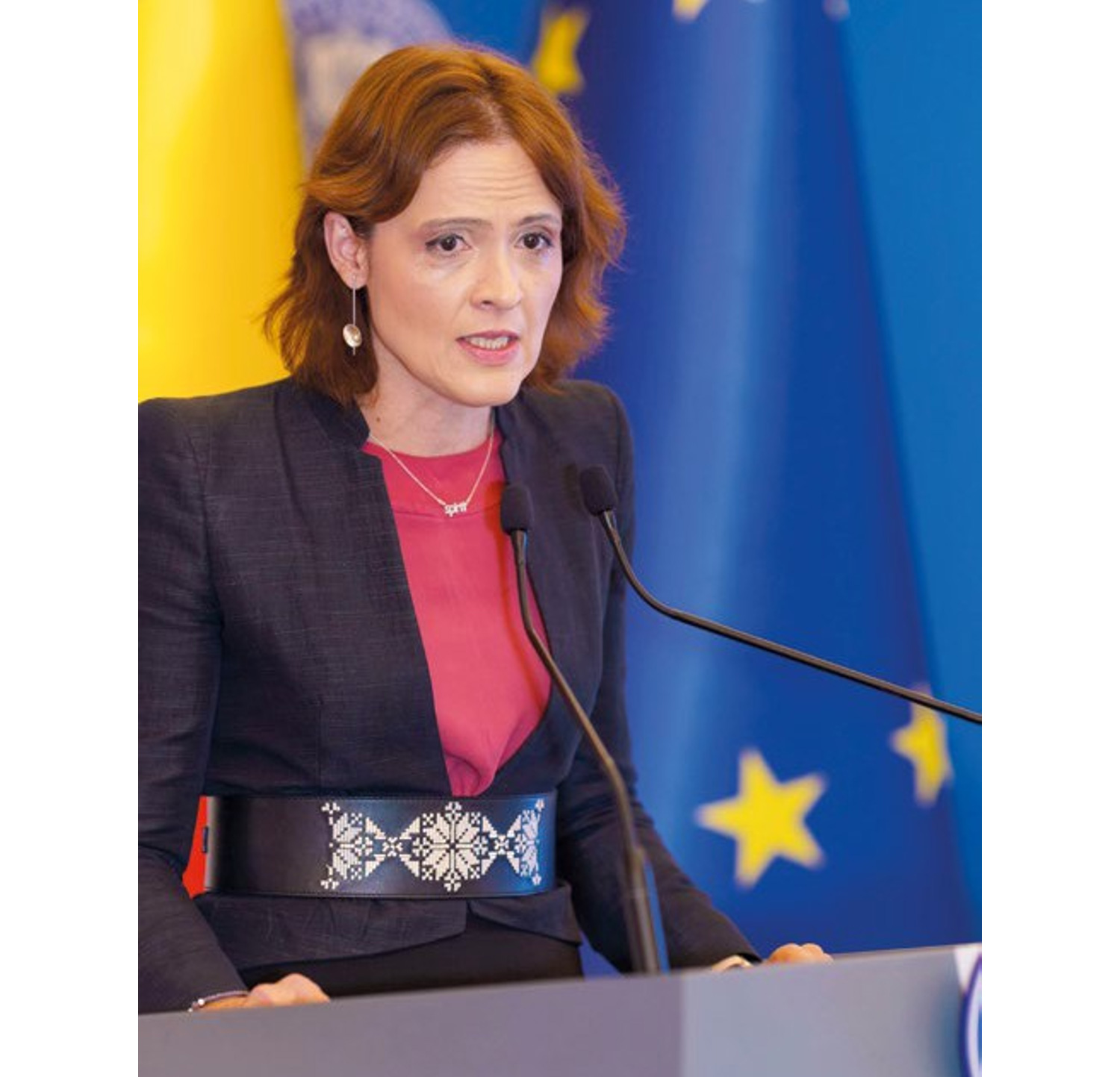
Silvia Dinică, PhD,
Secretary of State at the Ministry of Labour,
Family, Youth and Social Solidarity
and former two term senator
Romania’s Country Report was issued this month. The data tells a story we hear briefly when the report is released, while all eyes are on it. But then what? We rank last in the EU in innovation. We have the lowest share of tertiary-educated young people in the Union. And we are failing on the basics: over 40% of 15-year-olds fall below minimum proficiency in mathematics, reading, and science. The early school leaving rate in rural areas reaches 23.7% which is almost five times higher than in cities. Only one in fifteen adults in rural Romania holds a university degree. These are not footnotes. They are the weakness of a foundation on which every other ambition this country has is being built.
This year, I looked at these numbers through a new lens: the documents Finland published this spring—a vision for Finnish comprehensive education. Their purpose is to reposition the school as an institution of the common good, something bigger than a mere skills factory for the labor market. Romania has practiced a different process for a long time: one learns to pass the exam, to get into university, and to secure a job. Finland proposes something else: an education that forms people capable of acting for good, not merely people capable of executing tasks.
What is the meaning of hope in an educational document? Hope does not mean the student’s capacity to wait for good things to happen, but rather the understanding of one’s own agency to act for a better future, together with others. It means moving away from “it’ll do”, “nothing can be done,” or “that’s just how things are.” If schools were built around this active definition of hope, they would train entirely different citizens from those they produce today. The citizens most susceptible to authoritarian appeal are precisely those whom the school system has never given a genuine experience of agency, belonging, or a stake in the common future.
A well-functioning and safe school is a place where it is possible to fail and try again, and where everyone’s success is shared and celebrated. We, however, are still stuck in a different landscape: a culture of shame around failure, grades used as instruments of social ranking and an evaluation system that eliminates rather than develops.
The future school should be a source of meaning for teachers whose work must be characterized by having time to think, a strong sense of community and opportunities for professional growth. One cannot ask teachers to form citizens capable of democratic participation, ethical judgment, and collective agency if teachers themselves are treated as interchangeable units in an administrative system. What teachers experience in their professional lives is what they transmit, consciously or not, to their students. A demoralized teaching corps produces students with no model of what dignified, purposeful work looks like. The Finnish document rightly positions the teacher as a moral agent of the community.
There is a good distinction we could use to reframe our own education debate. It outlines three layers of skill. First, basic skills: literacy, numeracy, and digital navigation, they form the foundation. Romania is failing here. Nearly half of our 15-year-olds lack basic mathematics. Without this foundation, nothing else is possible. Transformative skills sit just above the foundation; these include critical thinking, ethical reasoning, the ability to learn how to learn, metacognitive awareness, and the capacity to imagine alternatives. These are the skills that cannot be automated, that AI cannot replace, and that democratic societies most urgently need. Our education system barely acknowledges their existence. Finally, existential skills sit at the deepest level, encompassing the ability to find meaning, to sustain hope in uncertainty, to understand oneself in relation to others and to the world, and to act with agency rather than resignation. These should be legitimate educational goals.
It is also worth mentioning Finland’s refusal to accept the dominant global framing: that schools should train humans to do what machines cannot. Finland says this is the wrong question. The right question is what humans should be, not what humans should be useful for. Thinking skills and ethical judgment are core goals not because they are economically valuable, though they are, but because they are what makes a person capable of living well, acting responsibly and participating in a democracy. In a world where AI can perform an expanding range of cognitive tasks, the humans who will matter most are not those who can execute fastest, but those who can judge wisest.
For Romania, the practical implication is stark. We are investing heavily in STEM, digital infrastructure and smart labs. These investments make sense only if they rest on a solid foundation of basic skills and are oriented by a framework of transformative and existential skills. Without that orientation, Romania will produce a small number of technically capable graduates surrounded by a large majority who are digitally illiterate, civically disengaged, and economically marginal. That is not a knowledge economy. That is a two-tier society with good fiber coverage.
