
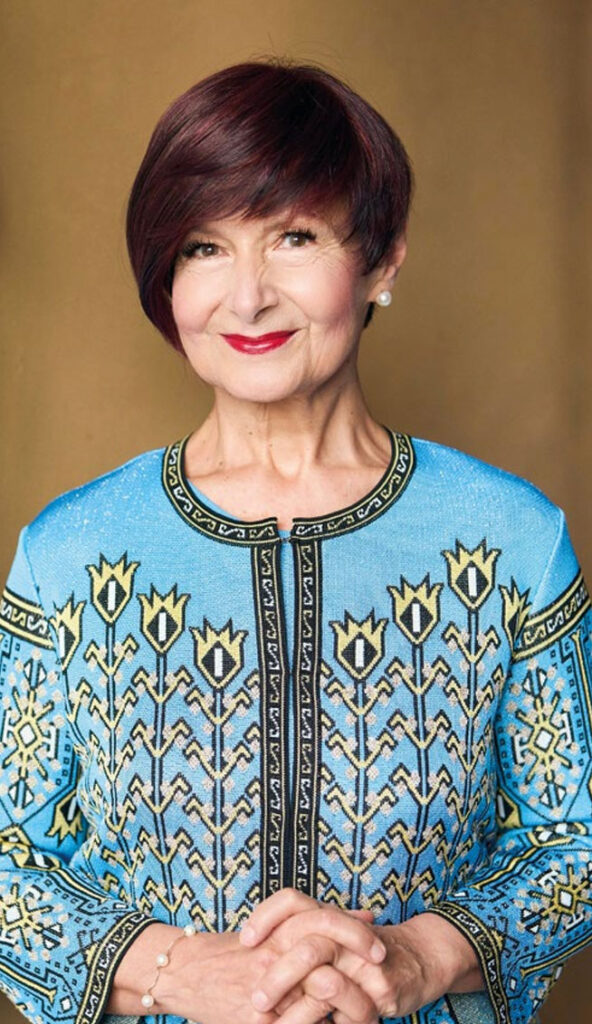
H.E. Simona-Mirela Miculescu
Ambassador Extraordinary and
Plenipotentiary, Permanent Delegate of
Romania to UNESCO
Former President of the UNESCO
General Conference
After a diplomatic career spanning more than 35 years, I can say with certainty that there is a reality diplomats know very well: not all bridges between people and nations are built through negotiations, treaties, or political declarations. Sometimes, the most enduring forms of closeness are born through culture, art, heritage, and a society’s capacity to make itself understood beyond strictly institutional language. Art possesses this rare power to create common ground where political positions may differ, where historical memory may be sensitive, or where diplomatic language reaches its limits. It does not erase differences, but makes room for them within a broader space of understanding. In this sense, cultural diplomacy is not a decorative appendage to classical diplomacy, but one of its most profound forms. Culture humanizes international relations. It gives a face, voice, and emotion to concepts that might otherwise remain abstract: peace, dialogue, diversity, solidarity. Culture and art are often the first common language between societies that do not share the same political positions or the same historical experiences. In multilateral arenas, art can create a platform for dialogue where classical diplomatic language encounters its limits. There are moments when a performance, a work of art, a piece of music, or a heritage element manages to generate more closeness and empathy than a political speech — precisely because they speak directly to human sensibility. Art also has the capacity to humanize major global themes. Conflicts, migration, accelerated technological transformation, polarization, or identity crises are often understood more deeply through culture than through statistics or political formulas. Culture introduces nuance, emotion, and human experience where public discourse sometimes risks becoming abstract or impersonal. Diplomacy and art share the capacity to build bridges between different sensibilities, memories, and identities. Both require listening, interpretation, nuance, and the ability to create shared meaning without erasing differences. Both the artist and the diplomat attempt, in different ways, to give form to complex realities and to create spaces of encounter between, sometimes, divergent perspectives. The artist and the diplomat work, at their core, with the same fragile material: perceptions, emotions, and collective imagination. In diplomacy, as in art, form matters almost as much as substance. Tone, symbols, cultural sensitivity, the capacity to inspire trust or create closeness profoundly influence the outcome of
dialogue. Sometimes, the difference between deadlock and progress lies precisely in this intelligence of nuance. There is also a deeply human dimension to diplomacy that is perhaps insufficiently visible from the outside. Beyond texts and negotiations, diplomacy remains the art of the relationship between people and cultures. It requires empathy, patience, the capacity to understand the other’s sensibilities, and to find common ground without negating differences. In this sense, diplomacy is very close to the artistic act: both seek to create connection and meaning in a complex world. A good diplomat, like an artist, must also have imagination — the capacity to see possibilities where others see only obstacles. In periods marked by tension and fragmentation, this ability to imagine bridges becomes essential. A very powerful example of the way art becomes diplomacy is the donation, made by Romania to UNESCO, in 2021, of the tapestry “Airplanes and Angels / Avioane și îngeri”, created by the artist Mircea Cantor. This donation took place in a particularly symbolic context, marking the 65th anniversary of Romania’s accession to UNESCO. It was the first Romanian work of art permanently displayed to the public at the UNESCO headquarters, a space of maximum 5 visibility, among emblematic works by Giacometti and Picasso. The significance of the work goes beyond its aesthetic dimension. The tapestry represents an adaptation to modernity of traditional craftsmanship and symbolic elements specific to woven rugs — an element inscribed on the Representative List of the Intangible Cultural Heritage of Humanity. Through this work, tradition is not merely preserved, but reactivated in a contemporary artistic language, capable of speaking to a global audience. The work’s message plays on the dualism between the creative and destructive capacities of the human being. In this sense, the work offers a remarkable artistic transposition of the preamble to UNESCO’s Constitution, according to which “since wars begin in the minds of men, it is in the minds of men that the defences of peace must be constructed.” Through its symbolic power, “Airplanes and Angels” expresses precisely this fundamental tension between destruction and creation, between violence and hope, between human vulnerability and our capacity to build peace. Through this donation, Romania conveyed a very clear cultural and diplomatic message: heritage is not a static reality, closed in the past, but a living
source of creation, reflection, and dialogue. Another recent moment of exceptional symbolic artistic and diplomatic value was the restoration of a vase belonging to the Cucuteni–Trypillia Civilization, which is the oldest work of art in UNESCO’s Collection. This vase, estimated to be more than 5,500 years old, was loaned to the organization by the Romanian state, in 1971, for a period of 99 years. It represents one of the oldest testimonies of human creativity in the organization’s collection and one of its most valuable pieces. Its restoration was not merely a technical intervention, but an act of cultural responsibility. It involved a close collaboration between our Romanian Permanent Delegation to UNESCO, the Organization’s Secretariat, the Cucuteni Eneolithic Art Museum “Gheorghe Dumitroaia” in Piatra Neamț, the International Research Centre for Cucuteni Culture, and the Neamț County Council, that provided the funding. Romanian experts traveled to Paris in several stages to carry out a meticulous restoration, based on reassembling the vase from its 44 original fragments, cleaning, treating, and chromatically integrating them. Beyond the heritage aspect, this undertaking carries a profound diplomatic significance. It demonstrates that the presence of an object in an international collection does not end the responsibility of the country of origin — it extends it. Romania showed that it actively assumes the protection of its cultural heritage, even when it is held in an international space. And for UNESCO, this example becomes a best practice regarding the role of member states in the conservation of works held in the organization’s collection. The Cucuteni–Trypillia vessel speaks of a civilization that flourished in what is now Romania, the Republic of Moldova, and Ukraine, millennia before the emergence of modern political borders. For this very reason, it carries a special symbolic force: it reminds us that art, spirituality, and creativity long preceded borders and political divisions. An object created more than five millennia ago continues today to convey a message about continuity and belonging to a shared human history. Art and diplomacy share the same vocation: that of bringing people closer together. Art does so through emotion, symbol, and imagination; diplomacy does so through dialogue, patience, and building trust. But both start from the same conviction: that differences need not become walls, but can become bridges. In a world marked by fragmentation, culture remains one of the most powerful forms of resistance against isolation, and one of the deepest resources for peace. That is why we have to cherish, protect, promote and support it much more!
