
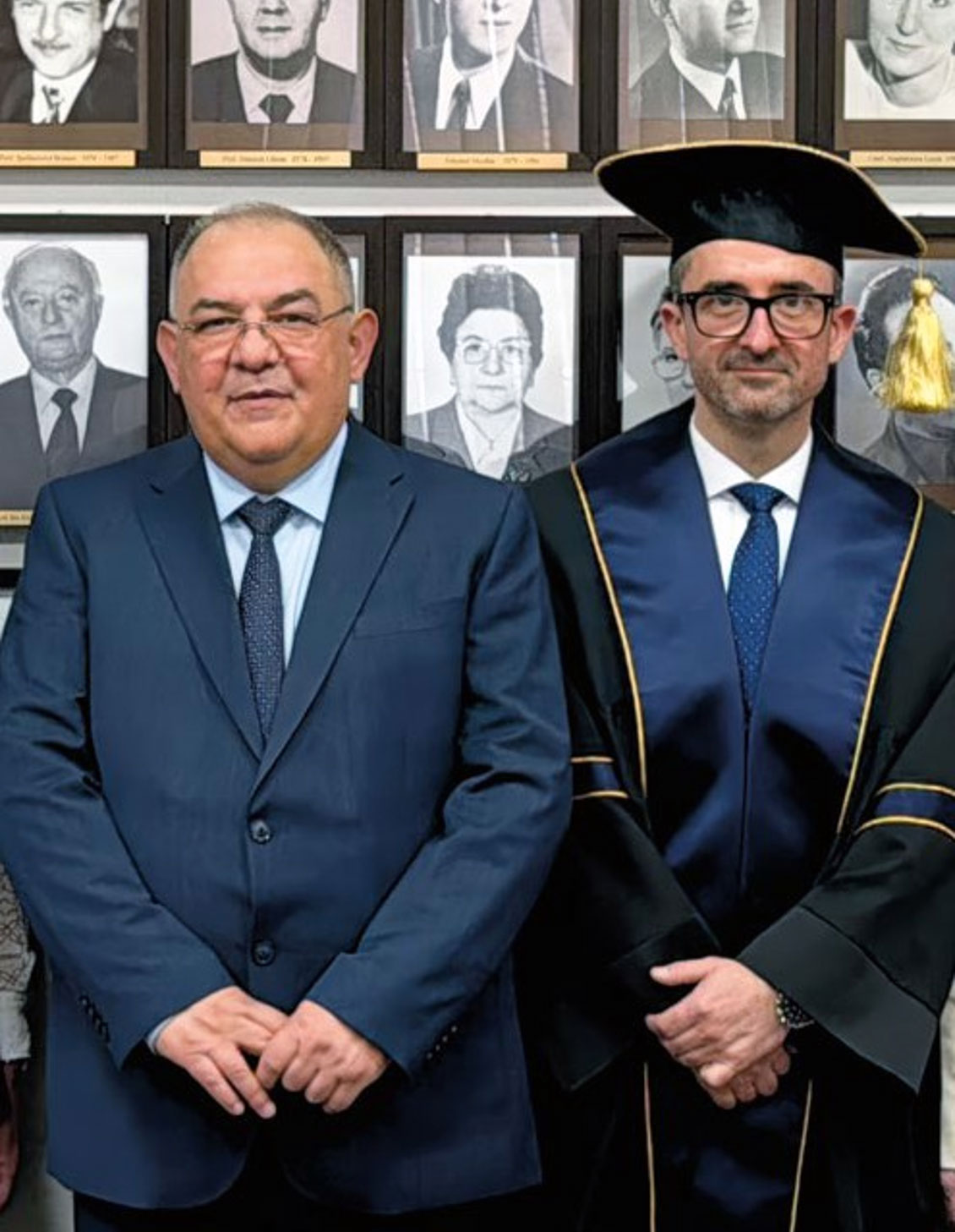
Prof. Octavian Crețu, MD, PhD,
Rector, Victor Babeș University of Medicine and Pharmacy Timișoara
Prof. Bogdan Timar, MD, PhD,
Dean of the Faculty of Medicine, Victor Babeș University of Medicine and Pharmacy Timișoara
In a context where medical education is continuously evolving, the development of university infrastructure has become an essential prerequisite for training future healthcare professionals.
The relevance of a university is undoubtedly reflected in the performance of its graduates, the educational and scientific achievements of its academic staff, and the impact of its research activities. At the same time, it must be supported by the capacity to expand and modernize its clinical base, medical simulation centers, and educational facilities in order to provide a contemporary environment for learning, research, and medical practice.
Over recent years, the Victor Babeș University of Medicine and Pharmacy Timișoara has taken significant steps toward modernizing its educational and research infrastructure through substantial investments designed to meet the demands of a rapidly transforming medical landscape. The development of the clinical base, the expansion of research infrastructure, and the establishment of state- of-the-art medical simulation centers represent strategic priorities for the university. These investments contribute directly to improving the quality of medical education and preparing students under conditions that closely mirror real-world clinical practice.
In contemporary medicine, access to advanced technologies and facilities adapted to modern teaching and research methodologies is no longer an advantage but a necessity. For this reason, UMF Timișoara has focused its efforts on developing an infrastructure capable of supporting both educational activities and academic and scientific excellence.
Medical simulation centers enable students and medical residents to practice complex procedures in a controlled and safe environment, contributing to the development of professional competencies before direct patient interaction. At the same time, investments in laboratories and research facilities create the conditions necessary for the implementation of competitive scientific projects at both European and international levels.
Furthermore, the modernization of educational spaces and university infrastructure reflects the vision of a forward- looking institution that recognizes the close connection between the advancement of medical education and the quality of the environment in which training takes place.
Through completed and ongoing projects, the Victor Babeș University of Medicine and Pharmacy Timișoara continues to strengthen its position among the leading academic institutions in Romania and the region, demonstrating that investment in infrastructure is, ultimately, an investment in the future of medicine and in the generations of healthcare professionals who will contribute to the development of healthcare systems.
Modernizing infrastructure is not merely about constructing new buildings or acquiring advanced equipment. It means creating an academic ecosystem in which education, research, and medical practice evolve together for the benefit of students, faculty members, and ultimately, patients.
The Ghiroda University Campus – One of the Most Ambitious Medical Academic Infrastructure Projects of the Current Leadership Mandate
A key milestone in the development strategy of the Victor Babeș University of Medicine and Pharmacy Timișoara is the creation of the new Ghiroda University Campus, a project that redefines the concept of academic space by integrating educational, scientific, cultural, and sports activities within a single modern complex.
Designed and implemented during the mandate of the current university leadership, the campus has been conceived to address both the needs of the educational process and the requirements of a continuously expanding academic community. This investment contributes to the expansion of university infrastructure while providing modern facilities for students, faculty members, researchers, and international collaborators.
The new complex includes dedicated educational facilities, featuring lecture halls, seminar rooms, and spaces designed for conferences and scientific events. At the same time, the campus will serve as an important venue for congresses, workshops, and national and international academic exchange programs, further strengthening UMF Timișoara’s role within the European academic environment.
However, the project extends beyond its educational dimension. The campus incorporates cultural and social facilities designed to support the development of an active and connected academic community. These include exhibition spaces, a multicultural center, student activity areas, and a large multifunctional hall capable of hosting academic and cultural events.
An important component of the investment is represented by its sports infrastructure. The complex includes modern facilities for sports and recreational activities, such as a multi-purpose sports hall, outdoor sports fields, and a swimming pool, providing students and university staff with additional opportunities to maintain an active and healthy lifestyle.
The campus also includes accommodation facilities dedicated to university guests, visiting professors, and participants in international academic programs, thereby supporting the development of institutional partnerships and collaborations.
Through its scale and complexity, the Ghiroda project represents one of the most significant investments made in medical academic infrastructure in Romania in recent years. The campus reflects a modern vision of medical education, where training, research, innovation, and university life are brought together within an integrated ecosystem designed for future generations of healthcare professionals.
