
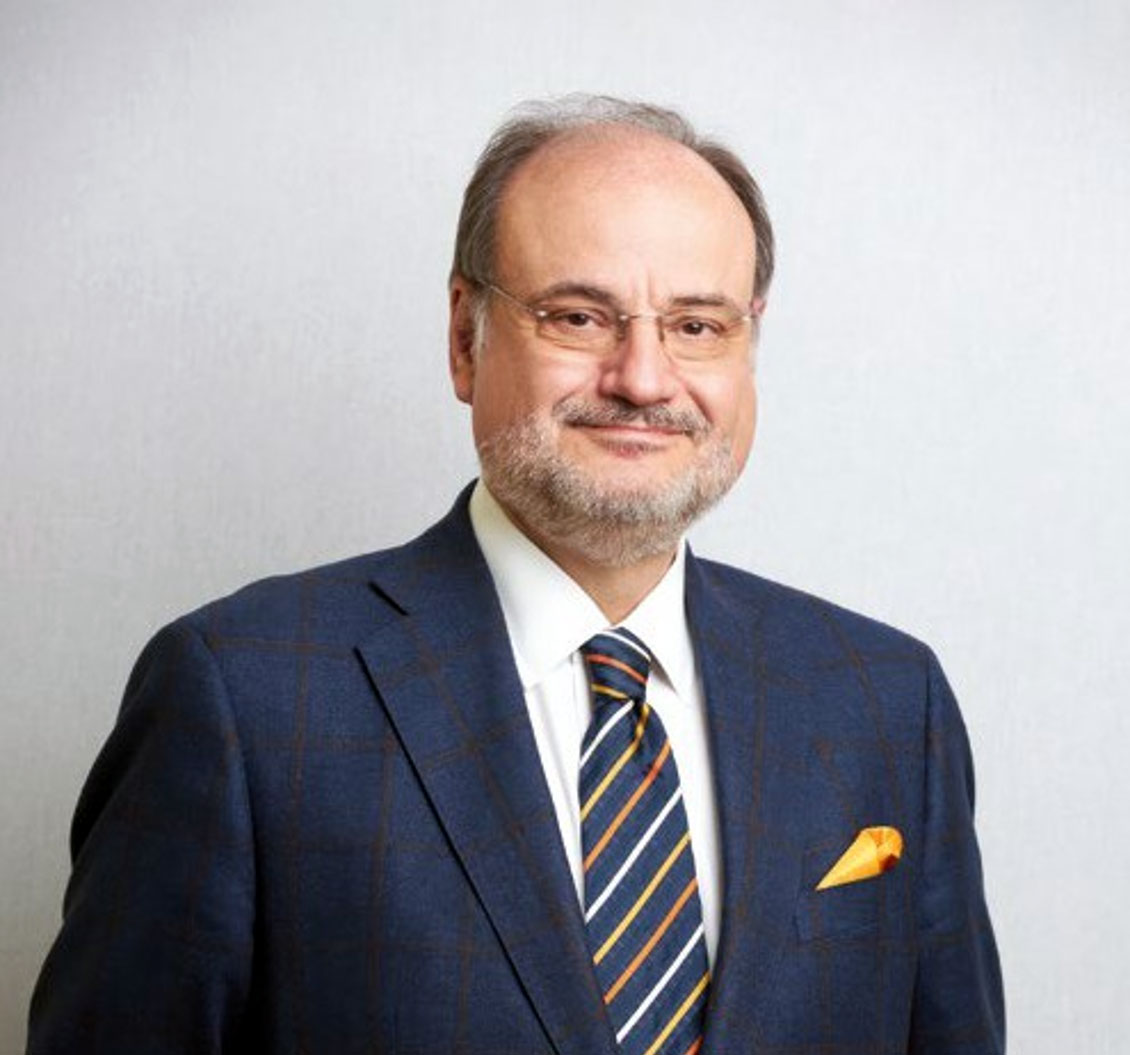
Prof. Univ. Dr. Habil. Horațiu Moldovan,
Professor of Cardiovascular Surgery at Carol
Davila University of Medicine and Pharmacy
Doctor of Medical Sciences Chief Physician,
Head of the Cardiovascular Surgery Department
at Bucharest Emergency Clinical Hospital
Full Member of the Academy of Medical Sciences
Full Member of the Romanian Academy ofSciences
President of the Romanian Society of Cardiovascular
Surgery (SRCCV)
President of the ROMTRANSPLANT Association
Cardiovascular diseases remain the leading cause of morbidity and mortality in our society, both globally and nationally. Most of these conditions benefit from interventional and surgical treatment.
Beginning in the second half of the last century, it was initially surgery that drove progress, giving rise to the specialty of cardiovascular surgery and, later, to the specialty of interventional cardiology. In Romania, this development occurred almost simultaneously with advances taking place worldwide, particularly in the United States and Western Europe.
The first open-heart surgery using extracorporeal circulation in Romania was performed in 1961 at FUNDENI Hospital, only eight years after the world’s first such procedure in
Philadelphia, USA, in 1953. Considering the differences in overall development between the two countries at the time, this near-simultaneity may seem surprising.
However, there is always an explanation. The opening of new directions – or entirely new paths – is often intertwined with the lives of exceptional individuals. Why exceptional? Because they possess uncommon qualities, talents, and abilities that set them apart from their contemporaries. Such individuals often seek new avenues through which to realize their vision and potential. The traditional path of professional advancement can be narrow; competition may be intense, and progress may even be hindered by leaders who, ideally, should be visionaries themselves. It is under such circumstances that a new direction emerges.
A new pathology that could not previously be addressed, a new technique, a new operation, and ultimately a new specialty. In this process, talent, courage, ambition, circumstance, and opportunity all play an essential role. And, to some extent, opportunities can also be created.
Like all surgical specialties, cardiovascular surgery emerged from general surgery. It was among the last surgical disciplines to establish itself as an independent field. Some even speculate that it may one day be among the first to be transformed beyond recognition. Diseases of the heart and blood vessels were traditionally managed by cardiologists, themselves descendants of internal medicine. They challenged surgeons, and often inspired them, to seek operative solutions for conditions that could no longer be adequately managed through medical therapy alone.
In Romania, the story unfolded in a similar way. During the first half of the twentieth century, the first rudimentary cardiovascular operations were performed, culminating in what would become the birth of the specialty: the first digital mitral commissurotomy, performed by Nicolae Hortolomei at COLȚEA Hospital in 1953.
Cardiac surgery, however, has a remarkable peculiarity: it addresses an organ without whose function the human body can survive only briefly. Successfully correcting cardiac lesions requires temporarily stopping the heart and replacing its function.
For centuries, the heart was therefore regarded as a noble organ whose mere manipulation was believed to inevitably lead to death. Replacing cardiac function is no simple task and requires highly sophisticated technology. For this reason, the era of modern cardiac surgery began only in the second half of the twentieth century, when technological advances made it possible to develop the materials and devices needed to achieve this goal. Thus, extracorporeal circulation was introduced: in 1953 in the United States by Gibbon and Kirklin, and in 1961 in Romania by Voinea Marinescu, Dan Setlacec, and Marian Ionescu.
After its beginnings at Colțea Hospital, cardiovascular surgery in Romania continued to develop at FUNDENI Hospital. A pioneering team performed more than 500 operations, often with modest results. Yet they persevered.
In 1973, Ioan Pop D. Popa and Radu Deac performed the first open-heart surgery using extracorporeal circulation at the County Hospital in Târgu Mureș, effectively laying the foundations of what would become the Institute of Cardiovascular Diseases and Transplantation, the country’s second historic reference center. For nearly two decades, the two centers, FUNDENI and Târgu Mureș, continued to develop the specialty. Their rivalry, both natural and productive, generated progress. Two schools of thought emerged, each training generations of disciples.
In 1976, Ioan Pop D. Popa succeeded in establishing cardiovascular surgery as a specialty distinct from general surgery within the Ministry of Health nomenclature. Numerous cardiac and vascular procedures were performed in both centers, particularly valve replacements and the correction of congenital malformations in older children. New instruments and devices were developed, including biological heart valve prostheses and textile vascular grafts. The results, however, remained less than ideal, partly because of the isolation and near-total information embargo imposed by the communist regime.
Yet the enthusiasm, determination, and passion of the pioneers, combined with an unexpected window of opportunity, sparked a revival. In 1978, a team of surgeons,
anesthesiologists, and perfusionists from South Africa, led by the renowned transplant surgeon Marius Barnard, began visiting Romania. They worked regularly at FUNDENI and Târgu Mureș, and later at the Central Military Hospital, where a cardiovascular section had been established under the leadership of
Vasile Candea. This moment, a unique event in the otherwise grey medical landscape of the communist years, proved to be a watershed in the development of the specialty. The results of cardiovascular surgery improved significantly and reached internationally acceptable standards. In my view, this encounter represents the true birth of modern cardiac surgery in Romania, and Dr. Marius Barnard may rightfully be considered one of its founding fathers.
An entire generation helped define this era: Ioan Pop
- Popa, Martin Constantinescu, Dan Făgărășanu, Dan Gherghiceanu, Ion Socoteanu, and Mircea Bârsan at FUNDENI, alongside Radu Deac, Mihai Liebhart, and Șerban Brădișteanu at Târgu Mureș. There were, of course, many others whose contributions were equally valuable.
Because Marius Barnard did not perform coronary surgery, and because coronary angiography was slower to become established as a diagnostic tool, aortocoronary bypass surgery was also slower to gain widespread adoption in Romania. Likewise, although Marius Barnard had participated in the world’s first heart transplant, this procedure also took longer to be introduced in our country.
The next major turning point came with the fall of the communist regime in 1989 and the openness that followed. The information embargo disappeared. Training fellowships became possible in major Western centers. Modern equipment and materials could be acquired, and new centers emerged in Cluj, Timișoara, and Iași.
A new generation of surgeons came to prominence: Vlad Iliescu, Vasile Răsvan, Andrei Iosifescu, and myself at FUNDENI; Horațiu Suciu at Târgu Mureș; Adrian Molnar at Cluj; Marian Gașpar and Mioara Cocora at Timișoara; and Grigore Tinică and Lucian Stoica at Iași. At the Central
Military Hospital, Viorel Goleanu, Iancu Mocanu, and Ionel Droc also played important roles. Again, there were many others whose contributions deserve recognition.
This generation continued the development of the specialty on a much larger scale. They advanced coronary surgery, the treatment of mechanical complications of myocardial infarction, surgery for aortic dissections and thoracic aortic aneurysms, as well as valve repair procedures, particularly mitral valve repair. Surgery for congenital heart disease also advanced significantly, especially in Târgu Mureș and Cluj.
Heart transplantation, the dream of every generation of cardiac surgeons, is undoubtedly linked to the center in Târgu Mureș. Although the first heart transplant in Romania took place at the Bucharest Emergency Clinical Hospital in 1999, it was performed by a team trained in Târgu Mureș: Șerban Brădișteanu and Radu Deac. Even the current transplant team led by Horațiu Moldovan, formed at FUNDENI, benefited from the mentorship and support of Horațiu Suciu from Târgu Mureș. The country’s most extensive transplant program remains in Târgu Mureș, where it was initiated by Radu Deac and subsequently developed by Horațiu Suciu.
As this generation reached maturity, another defining moment occurred: between 2010 and 2013, cardiovascular surgery entered the private healthcare sector. Private hospitals recognized the opportunity and invested heavily in modern facilities and advanced technological platforms. State-of-the-art equipment was acquired. Many outstanding specialists, particularly those who saw limited opportunities for advancement within the public system, chose this new path. New fields, including minimally invasive cardiac surgery, videothoracoscopic procedures, transcatheter interventions, and hybrid techniques, expanded rapidly in this environment. Over the past decade, private hospitals have become major drivers of technological innovation and development within the specialty.
The primary private hospitals currently developing cardiovascular surgery in Bucharest are SANADOR Clinical Hospital, MONZA-ARES, NORD Pipera, and PONDERAS.
Important centers also exist outside Bucharest, including Sf. Constantin and CLINICCO in Brașov, POLISANO in Sibiu, and PELICAN in Oradea.Notable surgical personalities have also emerged in this environment, including Victor Costache, Lucian Dorobanțu, and Theodor Cebotaru, among many others.
Today, approximately 20% of all cardiovascular procedures performed in Romania take place in Bucharest, and roughly half of these are carried out in private hospitals. What does the future hold?
Cardiovascular surgery is facing a profound transformation. The number of surgical procedures performed worldwide has declined as interventional techniques have advanced at an extraordinary pace. If percutaneous coronary angioplasty and coronary stents revolutionized the treatment of ischemic heart disease twenty-five years ago, new revolutions are now unfolding.
In 2002, Alain Cribier implanted the first percutaneous aortic valve (the first TAVI) opening the field of structural heart interventions. More than three million such procedures have since been performed worldwide. In many countries, the number of TAVI procedures is approaching or even exceeding the number of surgical aortic valve replacements.
Major aortic diseases, including aneurysms and dissections, are increasingly treated with endovascular prostheses, giving rise to the broad field of aortic endovascular therapy. These transcatheter procedures often require complementary surgical techniques, creating the domain of hybrid interventions. Three specialties increasingly collaborate, and sometimes compete in this space: surgery, cardiology, and radiology.
Which direction will shape the future? Integration or increasingly distinct specialization? The public sector or the private one?
The answers will belong to a new generation, our students, who will witness this future and help define it.
