
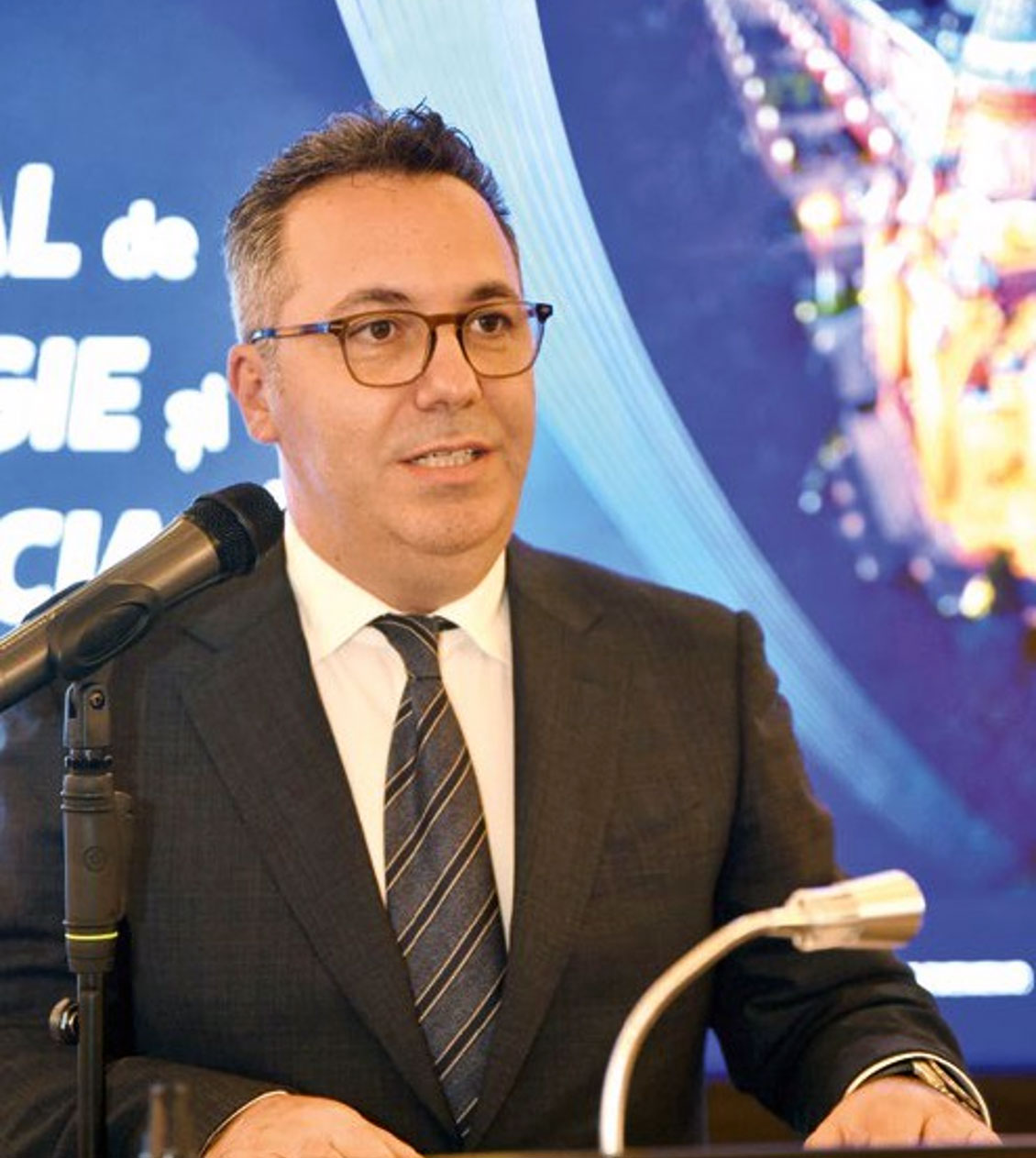
Prof. Univ. Dr. Răzvan Hainăroșie,
ENT Surgeon · Medical Director and Head of the ENT Discipline,
“Prof. Dr. Dorin Hociotă” Institute of Phono-Audiology and Functional ENT Surgery ·
Vice-Dean, Faculty of Medicine, “Carol Davila” University of Medicine and Pharmacy,
Bucharest · President, Romanian Society of ENT and Cervico-Facial Surgery
People ask me what it is that I actually do. The honest answer is that I work at the border between silence and sound, between the voice a person has and the voice they are at risk of losing. Otorhinolaryngology is often imagined as a specialty of small things — a sore throat, a blocked nose, an ear that will not clear on a flight. But the organs we look after are the ones through which a human being meets the world. We hear with them, we speak with them, we breathe and swallow through them. When they fail, the loss is rarely small. It is the loss of a conversation with a grandchild, the loss of a profession, sometimes the loss of the ability to eat without fear. That is the scale on which I have learned to measure my work, and it is the scale on which I would like to be understood.
If I had to name what matters most to me today, I would not name a single procedure or a single title. I would name a continuum — a way of thinking that runs from the institute where I work, in which colleagues restore hearing to the deaf, through the operations my own hands perform, and onward to the young surgeons who will outlive those hands. Four things hold that continuum together: defending the voice and treating cancers of the head and neck, the rhinosinusal surgery that opens the way, reaching the skull base through routes that spare the patient, and teaching. They are not separate ambitions. They are one ambition, seen from four windows. And around all of them stands an institution whose mission is broader still — including the return of sound to those who have lost it entirely.
An institute that returns people to the world of sound
I work within an institution that is, in fact, an entire hospital devoted to ENT — a rarity, and a place whose medical and academic life I am privileged to help shape as its medical director and as head of the ENT discipline. Of everything offered within its walls, the work I find most moving is something I do not perform with my own hands but stand behind with conviction: cochlear implantation. For a patient with profound sensorineural deafness, for whom hearing aids no longer help, the implant is, quite simply, the only technology capable of giving back the perception of sound. Each successful operation is, beyond the surgical act, the reintegration of a person into the world of sound and of human relationships. A child implanted early, then supported with patience, can grow up speaking. That is the quiet revolution our institute serves — and the reason I have chosen to champion a national registry for cochlear implantation, so that no patient remains invisible to the system.
The voice, and the cancers that threaten it
If hearing is how the world reaches us, the voice is how we reach the world — and it is under threat in ways most people underestimate. Romania sits among the countries with the highest incidence of laryngeal cancer in Europe. The principal cause is no mystery: it is tobacco, and the age at which people begin to smoke in our country is alarmingly young. The tragedy is not only that the disease is common; it is that patients too often arrive late, when the cancer is already advanced. In its early stages, a laryngeal cancer offers us many therapeutic options and a real chance to preserve the voice. Discovered late, those options narrow cruelly. This is why I speak publicly, again and again, about a symptom as ordinary as a hoarse voice that does not resolve. We must stop assuming it is only a cold. A persistent change in the voice deserves an examination, not patience.
Head and neck oncology is, for this reason, at the centre of my professional life. These are technically demanding operations, carried out in a region crowded with the great vessels and the nerves that govern movement, sensation, and speech. Exposing the carotid artery and the jugular vein is the critical moment of the dissection, the point at which experience and composure matter most. But the goal is never merely to remove disease. It is to remove disease while protecting the very functions — swallowing, breathing, speaking — that make the rescued life worth living. Oncologic surgery of the head and neck is, in the end, reconstructive thinking applied to survival.
Opening the way: rhinosinusal surgery and the skull base
A great deal of my own operating begins in the nose and the sinuses. Rhinosinusal surgery is sometimes dismissed as routine, but it is the discipline in which I learned the value of the endoscope — of seeing clearly, in high definition, through a corridor only millimetres wide, and of correcting disease while preserving the delicate architecture that governs how a patient breathes and smells. Chronic rhinosinusitis, nasal polyposis, the obstructed sinus that will not drain: these conditions shape daily life far more than most people admit, and treating them well is its own quiet craft. But the sinonasal corridors are also a doorway. Mastery of them is what makes the next step possible.
That next step has drawn me toward endoscopic surgery of the anterior skull base. Lesions that once required open approaches, with all the morbidity that implied, can increasingly be reached through the nose, along those same natural corridors, under endoscopic vision. The frontier between rhinology and neurosurgery has become a shared territory, and working there has taught me that progress in our specialty is often a matter of finding a less violent road to the same destination. Every millimetre of healthy tissue we preserve is a faculty the patient keeps. That is the philosophy I try to carry into the operating room: the most elegant operation is not the largest one, but the one that achieves its aim while leaving the person most intact.
Where our specialty is going
I am often asked where otorhinolaryngology is heading, and my answer has grown more optimistic with each year. The direction is unmistakable: less trauma, more precision,
and a steadily widening alliance between surgery and technology. Navigation systems now guide us through the sinuses and the skull base with a confidence that would have seemed reckless a generation ago. Intraoperative verification lets us confirm a result before the patient even leaves the table. Artificial intelligence is beginning to read scans and audiograms with a patience no human can sustain, and it will, before long, help us catch a laryngeal cancer or a hearing loss earlier than we manage today. I welcome all of it — but I am convinced the future of our specialty will not be decided by machines alone. It will be decided by whether we organise ourselves well: whether we build national registries, whether we screen newborns for hearing as a matter of course, whether we shorten the cruel delay between a first symptom and a first diagnosis. Technology supplies the instruments; it is leadership, and the willingness to reform the systems around the patient, that determines whether those instruments ever reach the people who need them. That conviction is what has drawn me, over the years, into roles well beyond the operating room.
On responsibility, and passing it on
I did not set out to collect responsibilities, but they have accumulated, and I have come to regard them as a single, coherent duty rather than a list. To lead the Romanian Society of ENT and Cervico-Facial Surgery is to be answerable, in some measure, for the standards of an entire profession. To serve on the national commissions that advise on our specialty is to help decide how it is practised and resourced across the country. To help coordinate the national residency examination — an undertaking that each year directs where thousands of young doctors will spend their formative years — is to hold, briefly, the future of the field in one’s hands. None of these are honours I display; they are weights I carry, and the only way I know to justify carrying them is to use them well. Authority in medicine is worth nothing unless it lowers the distance between a patient and the care they deserve.
What is left when the operating is done
And yet, if I am honest about what I consider most important in my activity today, it is none of these operations on their own, nor any of these offices. It is the obligation to pass them on. A surgeon’s hands have a limited number of years in them; a teacher’s influence does not. As Vice-Dean of the Faculty of Medicine at the “Carol Davila” University, I have come to see education not as a duty separate from surgery, but as its continuation by other means. A title can be inherited or assigned; what cannot be assigned is the trust of the young doctor who watches how you behave at three in the morning when an operation has turned difficult. That is the only form of leadership I have ever fully believed in — the kind that is taught by example and remembered long after the example is gone.
There is a phrase I keep returning to: that residency is not merely a professional step, but the beginning of a noble mission — the mission of transforming knowledge into care, and medicine into the art of healing. I believe that completely. The instruments will change; the technologies I use today will look quaint to my residents in twenty years. What will not change is the encounter between a frightened patient and a physician who has decided to be worthy of that fear. If I can pass on the technique, the judgement, and above all the seriousness with which one should approach another human being’s hearing, voice, or life, then the work outlives the worker. That, more than any single operation, is what I am trying to build.
So when I am asked what I do, I have learned to answer simply. I try to keep people’s voices, and to take cancer out of their throats and necks while leaving them able to speak and to swallow. I work in the nose and sinuses, and through them I reach difficult places at the base of the skull by gentle routes. I work within an institute where, alongside this, deafness is answered with sound. And I teach, so that all of it continues after me. These are not separate jobs. They are one promise, made over and over, to people who came to us on what was often the hardest day of their lives — and a promise I intend to keep making for as long as my hands and my voice allow.
