
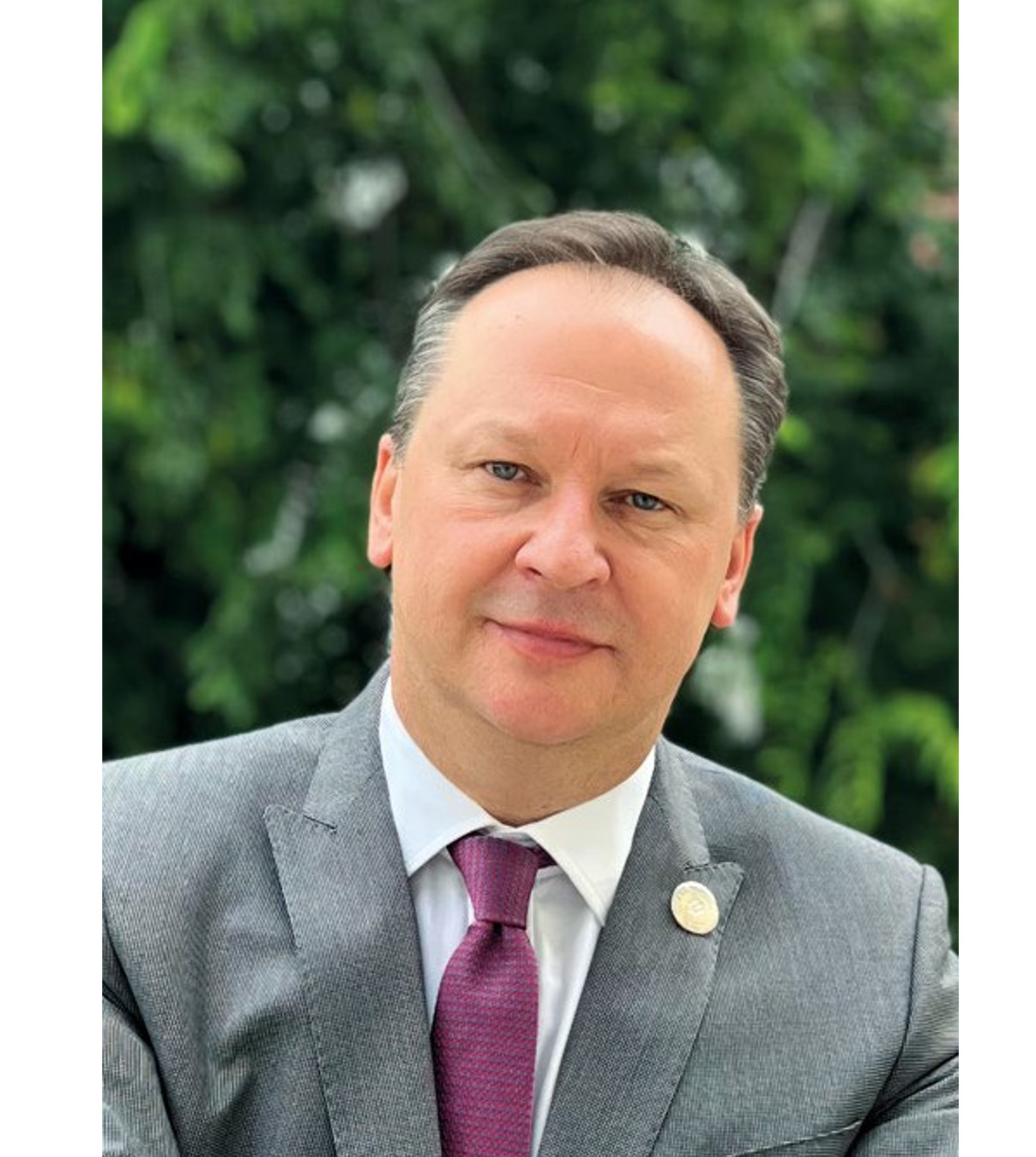
Remarks by His Excellency Ihor Prokopchuk,
Ambassador Extraordinary and Plenipotentiary of Ukraine to Romania
at the Diplomacy Conference within the “Bucharest Leaders’ Summit: United for Better Future”
(Bucharest, May 22, 2026)
We meet at a time when the security environment in the Black Sea region, across Europe and in other parts of the world undergoes dramatic shifts. Russia’s ongoing war against Ukraine continues to be the biggest threat to European and Euro- Atlantic security and prompts a profound reshaping of regional security arrangements.
There are several key considerations that I would like to highlight in my remarks.
First and foremost, I will emphasise what constitutes the biggest and immediate concern to Ukraine and its neighbours as well as countries far beyond – the ongoing unprovoked full-scale war of aggression waged by the Russian Federation against Ukraine which is now in its fifth year.
From the first day of the all-out invasion Ukraine stands firm in defending its sovereignty, political independence, territorial integrity, as well as values of freedom and democracy for itself and all nations of Europe. It is clear to us that while this war is existential for Ukraine, its outcome will also bear a defining impact on the Black Sea region as well as European and Euro-Atlantic security architecture.
What the Kremlin initially expected to be a matter of days has become the largest and most destructive armed conflict in Europe since the Second World War, with profound implications for the security of the entire Euro-Atlantic area.
According to Ukrainian assessments, Russia has suffered unprecedented military losses in personnel and equipment, demonstrating both the enormous cost of its aggression and Ukraine’s resilience and determination to prevail.
Ukrainian Defence Forces have destroyed vast quantities of Russian military equipment and have successfully challenged Russia’s naval dominance in the Black Sea. Ukraine has forced the Russian fleet to retreat to the eastern part of the sea while retaining the ability to strike military targets there.
Ukraine’s success in challenging Russia’s naval dominance has demonstrated that the security of the Black Sea is not predetermined by geography. It has also reaffirmed the strategic importance of freedom of navigation, protection of critical infrastructure and secure trade routes for the entire Euro-Atlantic community.
Failing to make decisive gains on the battlefield, the Russians have mounted a terror campaign against Ukrainian civilians targeting Ukrainian critical energy infrastructure. The past winter was the most difficult in this war when millions of civilians in Ukraine were left without electricity, water and heating in sub-zero temperatures for weeks. This terror and genocide were happening in the centre of Europe in the 21st century!
Although the low temperatures are now behind, russia continues to intimidate and terrorize Ukrainian civilians by massive attacks on a daily basis.
At the front, the Russians disregard their huge human losses and seek to maintain intensive offensive operations. They try hard to create an illusion of winning, but they are not. In fact, we assess Ukraine’s defence position to be the strongest of the past 10 months: we hold the frontline, increased the effectiveness of air-defence, minimised Russia’s advantage in personnel figures, maintain initiative in several areas, particularly through precision strikes, asymmetric tactics, and technological innovation. Ukraine’s strikes on russian ports and oil and gas export infrastructure, combined with sanctions pressure, are intended to force Russia to engage seriously in peace negotiations and bring an end to this terrible war.
Russia’s war against Ukraine is not a war for territorial gains, it is a forceful challenge to the rules-based security order, to the principles of sovereignty and territorial integrity, and to all main pillars of security architecture in Europe. This is why it matter to so many countries across the world.
Russia employs a full spectrum of hybrid tools: conventional warfare, energy blackmail, disinformation, cyber operations, weaponization of migration and food security. Its actions extend far beyond Ukraine’s borders and directly affect European and Euro-Atlantic security, global supply chains. The immediate effect is on our region and neighbours— including Romania. And therefore support to Ukraine is indeed a meaningful investment in security of every nation that provides such support.
When President Volodymyr Zelenskyy was on official visit to Romania in March, he signed with President Dan a Joint Declaration on establishment of strategic partnership between Ukraine and Romania – a historic development that set a solid framework for close bilateral cooperation on many tracks. They also signed a joint statement on defence equipment co-production, in particular drones, on the territory of Romania. This is a very important commitment that will serve to bolster defence industrial capabilities for our two countries. In the past years Ukraine’s defence sector has demonstrated remarkable resilience and adaptability.
Ukraine now possesses advanced potential in defence production—from drones and electronic warfare systems to advanced ammunition and armoured solutions. Currently, about 60% of the weapons in the hands of our Ukrainian Defenders are made in Ukraine. Ukraine’s drone industry has rapidly expanded, with now over 95% of drones used on the frontline being domestically produced.
There is a potential to do more, particularly as part of the initiative «Build with Ukraine / Build in Ukraine». This includes joint efforts to secure funding, establish production and support innovation. We urge partners to increase an investment in weapon manufacturing in Ukraine, particularly long-range missiles and drones.
Ukraine should increasingly be viewed not only as a recipient of security assistance, but also as a future provider of security, innovation and defence capabilities for Europe.
Finally, I would like to emphasize that, while stoically and courageously defending itself, Ukraine aspires for peace. Ukraine has repeatedly demonstrated its readiness for genuine peace efforts — peace that is sustainable, just, lasting and based on the norms of international law.
We maintain a firm view that any ceasefire must not become a tool for manipulation or a pause for renewed Russia’s aggression. A just and lasting peace requires accountability, security guarantees, respect to Ukraine’s sovereignty and territorial integrity.
In this context, the role of EU and NATO and the strengthening of its eastern flank are of critical importance. Looking ahead, few areas are of a priority significance from our perspective, among them:
- strengthening collective defense and deterrence along NATO’s eastern flank. Ukraine can make a very solid contribution to such defence efforts;
- increasing support for Ukraine’s defense capabilities, including air defense, long-range capabilities, defense industrial There is a need to further step up sanctions pressure on Russia. Also more needs to be done to enhance regional resilience against hybrid threats— disinformation, cyberattacks, and economic coercion.
Last but not least, let me emphasise that Ukraine’s path towards EU and NATO membership must not be viewed in separation from diplomatic and political efforts of restoration of peace in Europe. Success of Ukraine’s integration, which remains a sovereign choice of the Ukrainian people which they are now defending with weapons in their arms, will become an indispensable contribution to security and long-term stability in Europe.
Ukraine is acting now as a shield for all Europe and will remain a powerful contributor to European security in the longer term.
I thank all Romanians for supporting Ukraine in these defining times!
