
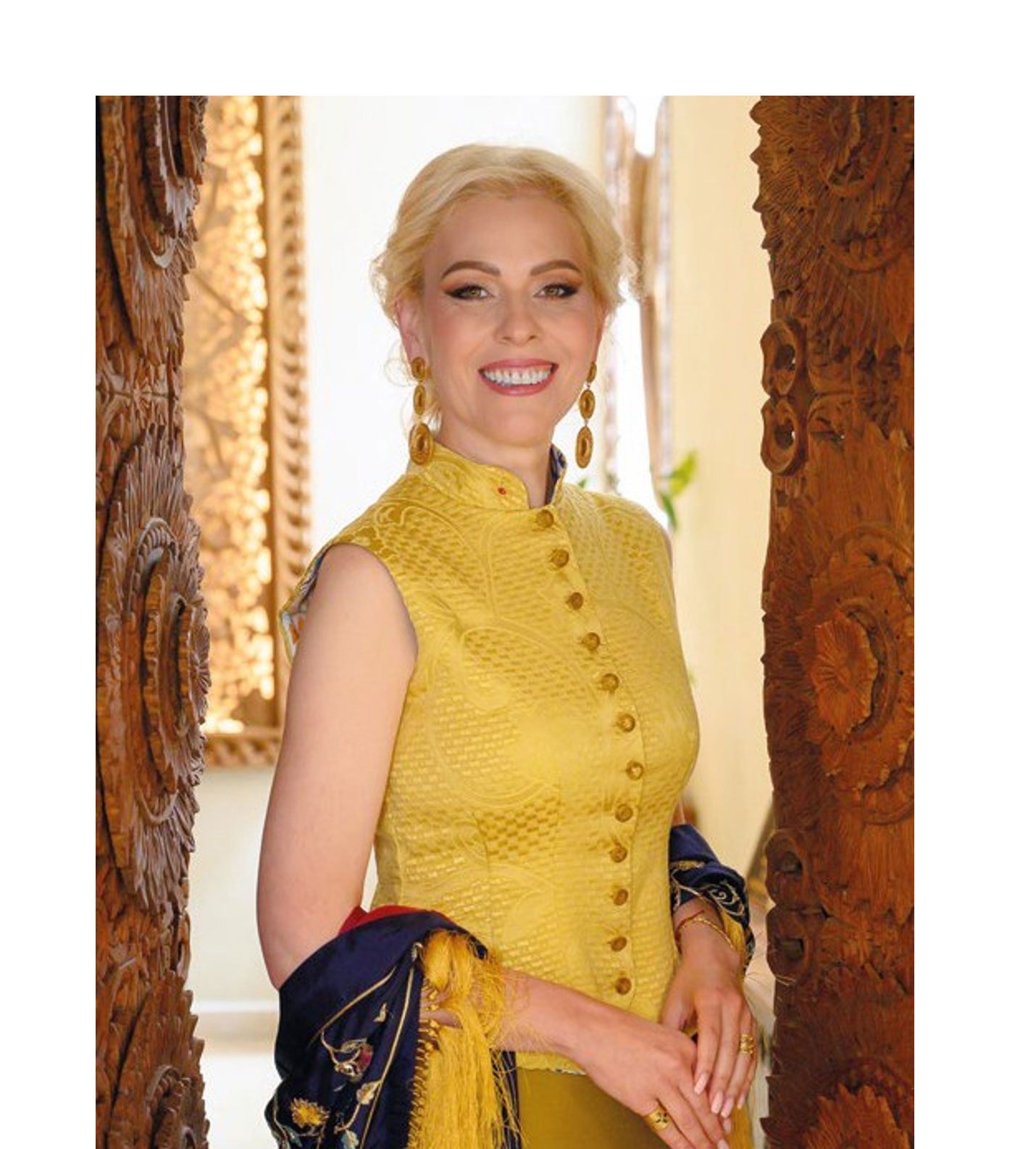
Marina Coanda Bundac,
Bonte Foundation
Venice Biennale, Geopolitics and the New Language of Influence
The world’s diplomats are still negotiating treaties, discussing security, and navigating geopolitical crises. But increasingly, another form of diplomacy is shaping international influence: one that happens not only in ministries and embassies, but in museums, concert halls, biennales, universities, festivals, and sometimes even on TikTok.
I was reminded of its power only days ago during the opening of the Venice Biennale, perhaps the most politically charged cultural event of the year. The atmosphere felt unusually tense. Additional security surrounded several pavilions, geopolitical fault lines were visible even in the language of contemporary art, and the world seemed to arrive in Venice carrying its anxieties. Yet amid all that tension, culture continued doing what it has always done best: creating conversations where politics often reaches its limits.
Romania’s pavilion this year, Black Sea: The Sea as a System, invites visitors to see the Black Sea not as a border but as a living organism, a network of histories, ecologies, economies, and human stories. At a time when the region occupies an increasingly strategic place in global affairs, the project offers a compelling reminder that geography may divide, but culture often reconnects.
From State-to-State Relations to Global Cultural Ecosystems
What fascinated me even more was another Romanian presence at the Biennale. Who would have imagined that Romania would help build a cultural bridge with Tanzania this year?
Alongside two Tanzanian artists selected for its national pavilion, Tanzania invited an international collective exhibition featuring creators from around the world. Romania is represented there through a work of artist Gheorghe Fikl from the BONTE Foundation collection, alongside artists from multiple continents. This may seem like a small detail, but it illustrates one of the most significant transformations taking place in cultural diplomacy today.
Influence is no longer generated exclusively through relationships between states. Increasingly, it emerges through networks of artists, foundations, universities, museums, collectors, curators, cultural entrepreneurs, philanthropists, and creative industries. The architecture of international influence has become far more decentralized than many diplomatic textbooks anticipated.
This evolution also explains the growing importance of public-private partnerships. International cultural excellence can rarely be sustained through public funding alone. Increasingly, sponsors, foundations, and private actors understand something that economists and diplomats are only beginning to articulate in the same language: investing in culture is investing in national reputation. And reputation, as it turns out, may be one of the most valuable strategic assets a country possesses.
Romania’s Soft Power Moment
This year offers Romania a remarkable opportunity to demonstrate exactly that. Through celebrations dedicated to Constantin Brâncuși and Nadia Comăneci, Romania can remind global audiences that its contribution to the world extends far beyond headlines and statistics.
Brâncuși remains one of those rare artists whose work feels simultaneously rooted in a place and universal in meaning. Recently, one of his sculptures crossed the symbolic threshold of one hundred million dollars at auction, attracting worldwide attention and reaffirming his place among the giants of modern art. The sale was not merely about the art market. It was about cultural prestige. Every time Brâncuși enters an international conversation, Romania enters it too.
The same principle applies to cultural heritage. The recent recovery and return of elements of the Dacian Treasure generated substantial international media attention and renewed interest in Romania’s historical narrative. In an era increasingly shaped by questions of identity and belonging, heritage is no longer simply about preserving the past. It has become a diplomatic asset capable of strengthening a nation’s confidence in its future while reinforcing its international visibility.
Why Reputation Has Become Strategic Infrastructure
Today, countries are evaluated almost as carefully as companies. According to the latest Brand Finance Global Soft Power Index, Romania has continued its upward trajectory, climbing from 55th place globally in 2025 to 53rd place in 2026. The ranking measures perceptions across more than one hundred countries and evaluates influence through dimensions such as culture, governance, business, education, diplomacy, trust, media influence, and international reputation.
The numbers themselves are encouraging, but the larger lesson is even more important. Nation branding is no longer a marketing exercise; it has become strategic infrastructure. It influences investment decisions, tourism flows, talent attraction, partnership opportunities, and even geopolitical credibility. In other words, a country’s reputation increasingly functions as a form of national capital.
For decades, governments focused on roads, ports, railways, airports, and digital connectivity as the foundations of competitiveness. These remain essential. Yet in an interconnected world, perception itself has
become infrastructure. Countries now compete not only for markets but for attention, not only for resources but for trust, and not only for economic partnerships but for relevance. Increasingly, relevance is built through stories.
Romania, OECD and the Economics of Trust This reality becomes especially relevant as Romania advances toward OECD membership, one of the country’s most significant strategic objectives. Discussions about accession often focus on technical reforms, governance standards, economic indicators, and regulatory alignment. These dimensions are undeniably important, but there is another component that receives less attention: trust.
Membership in the OECD represents recognition by a community of countries committed to transparency, innovation, institutional quality, and democratic governance. It is not merely a reflection of economic readiness; it is also a signal of credibility. Recent OECD analyses have increasingly emphasized the importance of intangible assets, including trust, human capital, social cohesion, innovation capacity, and institutional confidence, as drivers of long-term resilience and competitiveness.
These are precisely the areas where culture and diplomacy intersect. A country that is trusted attracts partnerships more easily, attracts investment more easily, and exercises influence more effectively. Cultural diplomacy contributes directly to this ecosystem of trust because trust, much like reputation, accumulates slowly but generates extraordinary strategic value.
In the Age of Algorithms, Authenticity Matters More Than Ever
Of course, influence today is becoming more complicated. We live in an era where the line separating public diplomacy, strategic communication, and propaganda is increasingly difficult to identify.
Modern propaganda rarely arrives wearing a uniform. It appears instead as a viral video, a perfectly edited clip, a misleading image generated by artificial intelligence, or a highly emotional narrative designed for maximum algorithmic performance. The battlefield of influence has become digital, emotional, and astonishingly fast.
This is precisely why authentic cultural diplomacy matters more than ever. Unlike propaganda, it does not manipulate fear. Unlike disinformation, it does not depend on distortion. Its objective is not persuasion at any cost but understanding. It seeks to build relationships that endure beyond political cycles, election campaigns, and news headlines.
The Future of Soft Power
Several trends are already reshaping the future of cultural diplomacy.
- First, culture is becoming increasingly Today’s diplomatic conversations involve not only museums and performing arts but also gaming, artificial intelligence, design, fashion, gastronomy, sports, and sustainability.
- Second, authenticity is becoming more influential than Audiences around the world increasingly trust genuine stories more than carefully polished campaigns. In an environment saturated with content, credibility has become a scarce and valuable currency.
- Third, younger generations are transforming how culture is created, consumed, and Generation Z and Generation Alpha navigate a world where identities are simultaneously local and global, physical and digital, human and increasingly AI-assisted. Their expectations are reshaping not only cultural consumption but also the very mechanisms through which countries build influence.
The challenge for diplomats, cultural institutions, and policymakers is therefore not simply to adopt new technologies but to preserve authenticity while navigating algorithms. The countries that succeed will not necessarily be those with the loudest messages. They will be those with the most credible ones.
Beyond Influence
Throughout my years of experience in cultural diplomacy, I have often witnessed moments when music, art, dance, or shared cultural experiences succeeded where official speeches could not.
One such moment remains particularly vivid from the one of the thirteen editions of the IWA Diplomatic Charity Bazaar that I had the privilege of chairing. In 2012, shortly after Palestine was granted non-member observer state status at the United Nations, a moment widely perceived by many Palestinians as a powerful form of international recognition, nearly twenty Palestinian dancers travelled to Bucharest to participate in the event. They performed before representatives of more than fifty countries. They did not deliver a political statement, discuss negotiations, or present a strategic vision. They danced.
For a few minutes, between flags, diplomatic sensitivities, and competing geopolitical narratives, what filled the room was something profoundly human. That moment taught me more about cultural diplomacy than many policy papers ever could. Music, dance, art, and shared emotion can sometimes go where official diplomacy cannot.
Perhaps that is the enduring lesson of cultural diplomacy. The world may become more digital, more automated, and more interconnected, yet influence will still depend on deeply human qualities: curiosity, empathy, creativity, and trust.
Because in the end, countries are remembered much like people are.
Not only for what they achieved. Not only for what they negotiated.
But for what they left behind in the memory of others.
And that memory, built through culture, trust, and human connection, may be the most valuable form of power a nation can possess.
