
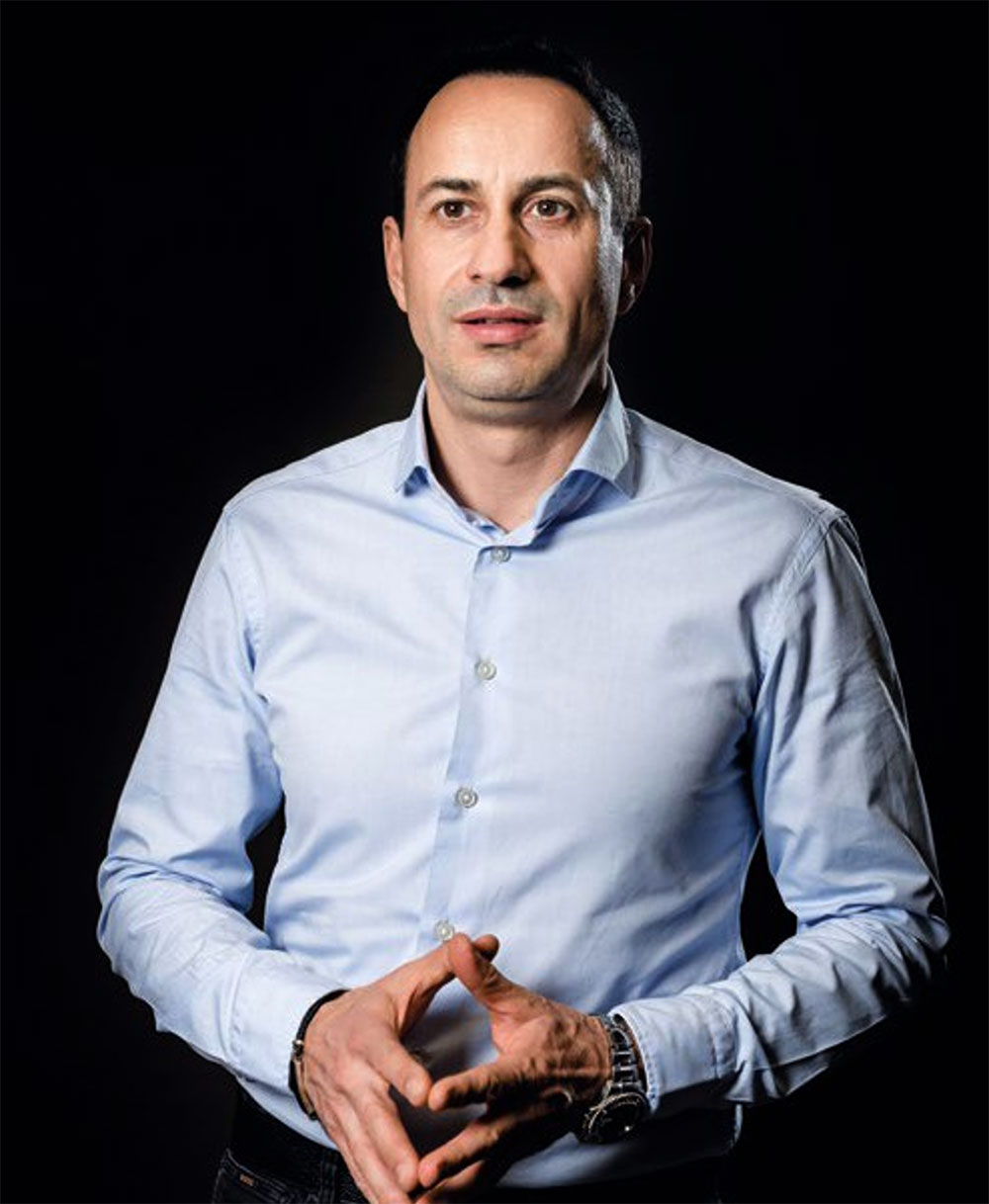
Răzvan Boberis, MD,
CEO Clinica 32
In complex implant rehabilitation, precision does not begin in the surgical room. It begins much earlier, in the way the case is diagnosed, planned and coordinated before the first clinical step is taken.
This is one of the most important changes in modern dentistry. Advanced implant treatment is no longer defined only by surgical execution, but by the quality of the digital workflow behind it. The more complex the case, the more important it becomes to connect diagnosis, prosthetic planning, guided surgery and laboratory execution into one coherent medical process.
In full-arch implant rehabilitations, especially All-on-X treatments, the central question is no longer simply: where can implants be placed? The better question is: where should the implants be placed so that the future restoration is functional, stable, aesthetic and sustainable over time?
This shift is essential. A successful rehabilitation is not built around implants alone. It is built around the final prosthetic result: the future teeth, the bite, the smile line, the facial support, the phonetics, the hygiene possibilities and the long-term comfort of the patient. The implant is not the final objective. It is the support structure for a prosthetic plan that must be designed before surgery.
That is why digital planning has become a cornerstone of predictability in advanced implantology.
Radiographs, cone beam computed tomography, intraoral and extraoral photographs, intraoral scans, digital smile design and prosthetic simulations are not optional technological additions. They are diagnostic and planning instruments. They help the medical team understand bone volume, anatomical limitations, soft tissue architecture, aesthetic parameters and the relationship between the future prosthesis and the patient’s functional needs.
Once this information is integrated, the treatment can be planned backwards from the desired result. The future restoration guides the implant positions. The implant positions guide the surgical strategy. The surgical strategy guides the clinical execution.
This is where the surgical guide becomes essential.
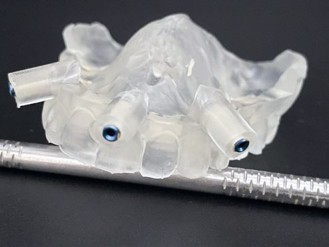
A surgical guide is a custom-made device designed from the patient’s digital data and prosthetic plan. Its role is to transfer the virtual implant plan into the clinical reality of surgery. It guides the position, angulation and depth of implant placement according to a strategy established before the intervention.
But the surgical guide is more than a technical instrument. It is the physical expression of the digital plan. It connects the CBCT, the intraoral scan, the prosthetic design and the surgical act. In full-arch rehabilitations, where every millimetre can influence the final result, this connection is critical.
Guided surgery does not replace clinical judgement.
It gives clinical judgement a more precise framework. The guide does not make decisions for the doctor, and it does not eliminate the need for experience, surgical skill or intraoperative adaptability. What it does is reduce unnecessary uncertainty and help the team execute a carefully designed plan with greater control.
At Clinica 32, we see digital planning as the link between surgery and prosthetics. In complex implant rehabilitation, the surgical team, the prosthetic team and the dental laboratory should not work as separate stages that meet only after the intervention. They must be aligned before treatment begins.
This alignment becomes particularly important when the provisional restoration is part of the treatment plan.
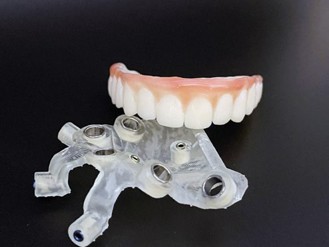
In All-on-X rehabilitations, the provisional prosthesis is not an accessory added at the end of the surgery. It is a planned component of the digital workflow. In eligible cases, when implant stability and clinical conditions allow it, the provisional fixed restoration can be delivered immediately after surgery or within a maximum of six hours.
This is not the result of speed. It is the result of preparation. For same-day or immediate provisionalization to be possible, the essential elements must be planned in advance: the future tooth position, the prosthetic space, the implant distribution, the occlusion, the relationship between the implants and the provisional restoration, and the laboratory protocol that makes delivery possible within a controlled timeframe.
In other words, the intervention becomes more predictable not because the case is simple, but because the complexity has already been anticipated.
This distinction matters. In advanced dentistry, efficiency should never mean haste. A fast result has value only when it is the consequence of rigorous planning. The goal is not to shorten treatment artificially, but to reduce improvisation, align the team and make each clinical stage serve the same final objective.
The surgical guide and the immediate provisional restoration are therefore not two separate achievements. They are two visible outcomes of the same philosophy: prosthetically driven digital planning.
The guide transfers the plan into surgery. The provisional restoration proves that the prosthetic stage was considered before the surgical act. Together, they show that the treatment has been designed as an integrated medical workflow, not as a sequence of disconnected procedures.
This is the direction in which complex implant dentistry is evolving: toward interdisciplinary planning, digital precision and controlled execution.
Technology is essential, but technology alone is not enough. A CBCT scan, an intraoral scan or a surgical guide cannot compensate for incomplete diagnosis. A provisional prosthesis delivered quickly has value only if it is part of a well-structured medical plan. Digital tools must support expertise, not replace it.
For a clinic, adopting this standard is not simply a technological upgrade. It is a professional commitment. It requires digital infrastructure, clinical experience, laboratory coordination and a culture in which the final result is planned before the intervention begins.
At Clinica 32, complex dentistry is not built on improvisation. It is built on diagnosis, planning, technology, communication and medical responsibility. The more complex the case, the more important this structure becomes.
In full-arch implant rehabilitation, the surgical guide and the provisional restoration delivered immediately or within six hours represent more than clinical efficiency. They represent a way of working in which surgery, prosthetics and laboratory execution are connected from the start.
The future of complex implantology belongs to teams that can connect data, diagnosis, surgery, prosthetics and digital execution into one coherent workflow.
Because in advanced dentistry, precision begins before surgery. Predictability begins before the intervention. And the final result begins with a plan.
