
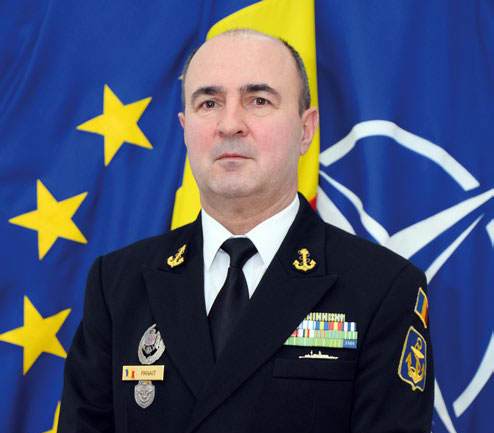
Chief of the Romanian Naval Forces
Vice Admiral Mihai Panait
Tradition, discipline, and excellence — these are the values that define the educational institutions of the Romanian Naval Forces, where generations of naval personnel have taken their first steps toward careers built on responsibility, professionalism, and teamwork.
In an increasingly dynamic and complex international environment, naval military education plays a vital role in preparing leaders capable of responding to today’s maritime security challenges. From classrooms and modern laboratories to training voyages and onboard activities aboard military vessels, the educational institutions of the Romanian Naval Forces represent far more than centres of learning — they are places where character is shaped and future leaders are forged.
The “Mircea cel Bătrân” Naval Academy remains the foremost institution of higher naval education in Romania. With a tradition spanning more than a century, the Academy continues to educate officers for the Romanian Naval Forces, as well as specialists for the civilian maritime sector, constantly adapting its educational process to evolving technological and operational requirements. Academic programmes, practical exercises, and international partnerships all contribute to shaping professionals capable of operating effectively in an ever-changing security environment.
An equally important role in the preparation of military personnel is played by the “Admiral Ion Murgescu” Naval Forces Military School of Petty Officers, an institution that trains specialists in essential fields required for the effective functioning of naval structures. Through an educational process based on rigour, practical training, and adaptability, students are prepared to operate modern technical equipment and systems indispensable to missions carried out by the Romanian Naval Forces.
Beyond academic achievement and military training, the educational institutions of the Romanian Naval Forces contribute to the development of fundamental values such as discipline, honour, responsibility, and comradeship — values that define the military profession and accompany young people throughout their careers.
Today, more than ever, the Romanian Naval Forces invest in education, technology, and professional development, fully aware that the future of maritime security depends not only on modern equipment and capabilities, but above all on the people who operate them. Behind every generation of leaders stand the institutions that have trained, inspired, and prepared them for the challenges of an ever-changing world.
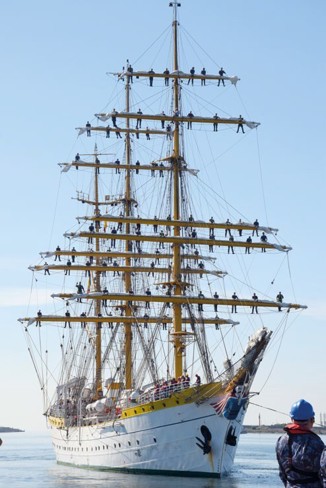
“Mircea cel Bătrân” Naval Academy — Training Tomorrow’s Naval Leaders
The “Mircea cel Bătrân” Naval Academy is the flagship institution of Romanian maritime education. With a tradition preserved for more than 153 years, the Academy benefits from a modern infrastructure spread across a 27-hectare campus, fully comparable to that of prestigious maritime educational institutions worldwide.
The Academy’s academic infrastructure and training facilities include more than 60 simulators, laboratories, classrooms, and specialised training rooms equipped with modern technology, an Olympic-size swimming pool, a seamanship training base, study areas, a library with dedicated reading rooms and approximately 200,000 volumes, a museum, and various social and recreational facilities.
In addition, the Academy operates a Training Ships Formation comprising the training ship “Mircea”, motorboats, and other training craft. At present, the training ship “Mircea” is conducting a transatlantic voyage lasting five months, with port calls on three continents: Europe, Africa, and North America. This is the ship’s fourth Atlantic crossing, following the historic voyages of 1976, 2004, and 2009. In July, the cadets on board will participate in the events marking the 250th anniversary of the Independence of the United States of America.
A symbol of Romanian maritime education, the “Mircea cel Bătrân” Naval Academy stands today as the heir to 153 years of tradition in the training of both naval and civilian officers and represents a defining institution within Romania’s polytechnic higher education system.
Under the coordination of the Ministry of National Defence, the Academy was classified in 2011 as a “University of Education and Scientific Research” and became ISO- certified for the implementation of its quality management system — a distinction unique within Romanian military education and among the few within civilian higher education. Since 2009, the institution has also been evaluated by ARACIS and awarded the rating “High Degree of Confidence”.
Today, the Academy’s organisational structure reflects contemporary educational and operational requirements and ensures the fulfilment of its institutional mission and strategic objectives.
The current structure includes two faculties, a lifelong learning centre, a research centre, command and administrative structures, as well as teaching and logistical facilities such as the library, sports complex, and training centre. The Faculty of Marine Engineering comprises three departments and a postgraduate school, while the Faculty of Navigation and Naval Management includes two departments.
The Academy currently offers five bachelor’s degree programmes across three fields of study and six master’s degree programmes in three academic fields, all organised in full-time education. Since 2018, the Academy has also coordinated the education and training of Naval Architecture midshipmen enrolled through the “Dunărea de Jos” University of Galați, providing academic, logistical, and financial support. Beginning with the 2022–2023 academic year, the Academy introduced its first bachelor’s degree programme taught entirely in English.
Romanian Naval Petty Officers School —
Shaping the Backbone of Naval Power
In any modern navy, operational strength is defined not only by ships and strategic doctrine, but also by the highly skilled professionals who ensure technical readiness, maintain complex systems at sea, and lead small tactical units with precision. Within the Romanian Naval Forces, this essential role belongs to the petty officer — and the foundation of that expertise is the Romanian Naval Petty Officers School.
As a post-secondary military education institution subordinated to the Romanian Naval Forces Staff, the school represents a cornerstone of Romania’s maritime professional training system. Its mission is both clear and strategically significant: to prepare specialists capable of operating, maintaining, and repairing naval weapons systems and technical equipment while developing leadership skills at the tactical level of teams, groups, and ship crews.
The educational programme spans two years and combines rigorous academic instruction with intensive practical training. Students — future petty officers — are trained not only as technical experts but also as military leaders capable of making decisions in demanding operational environments. The curriculum is designed to ensure both technical proficiency and leadership development, reflecting the dual nature of the profession: technician and leader at sea.
A defining element of the educational process is its strong operational component. Cadets undertake practical training aboard military vessels of the Romanian Naval Forces, gaining direct exposure to real naval environments and operational conditions. This experience enables graduates to transition seamlessly from education to active service, fully prepared for the realities of maritime operations.
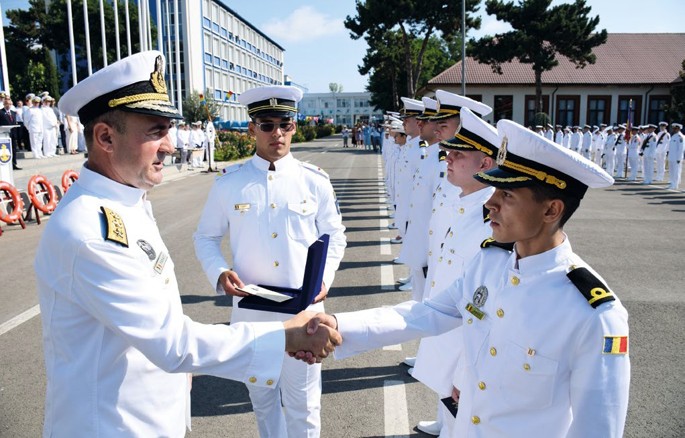
The importance of petty officers has grown significantly in the context of modern naval warfare and the strategic relevance of the Black Sea region. Contemporary naval platforms integrate advanced propulsion systems, weapons, sensors, and communication technologies, and petty officers stand at the centre of this operational complexity. They ensure technical functionality, troubleshoot critical systems, and sustain the technological backbone of the fleet.
Beyond technical expertise, the Romanian Naval Petty Officers School places strong emphasis on character development, discipline, and ethical conduct. Graduates are expected to embody military values, resilience, and adaptability — qualities essential for service in dynamic and often unpredictable maritime environments. At the same time, the institution ensures that students acquire competencies equivalent to those offered within civilian post-secondary education systems, enabling professional recognition beyond the military framework.
One of the greatest advantages of this educational path is career stability and professional progression. Upon graduation, all students are assigned positions corresponding to their specialisation within the Naval Forces or other structures of the national defence system. The military career path provides clear opportunities for advancement, continuous professional development, and service in diverse operational and technical roles.
In a broader strategic context, the school plays a vital role in strengthening Romania’s naval capabilities. As maritime security challenges continue to evolve — from regional instability to technological modernisation — the demand for highly trained technical personnel continues to grow. The Romanian Naval Petty Officers School ensures that the fleet is supported not only by modern platforms, but also by competent professionals capable of maximising their operational effectiveness.
Ultimately, the “Admiral Ion Murgescu” Naval Petty Officers School remains a strategic pillar of naval readiness and a gateway to a profession defined by responsibility, expertise, and service at sea.
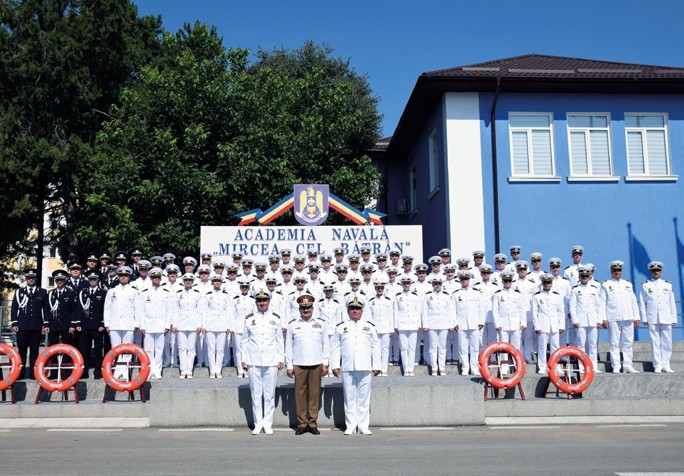
“Alexandru Ioan Cuza”
National Military College — The Starting Point of a Military Career
Discipline, performance, and military tradition — for more than a century, the “Alexandru Ioan Cuza” National Military College has shaped generations of young people who chose to build their future on responsibility, courage, and academic excellence. For many students wearing the military uniform for the first time, the college represents the beginning of a professional journey founded on strong values and the ambition to become the leaders of future generations.
With a tradition of nearly 145 years in military secondary education, the institution, subordinated to the Romanian Naval Forces Staff, remains one of the most prestigious military colleges in Romania. Throughout its history, the college has educated thousands of graduates who pursued military careers, many of whom later became officers, commanders, and specialists within various structures of the Romanian Armed Forces.
The institution continues a long tradition of naval education in Romania that began in 1881 with the establishment of the Navy Children’s School in Galați. Initially created to educate the children of military personnel and prepare young men for naval service, the institution underwent numerous reforms and reorganisations over time. In 1973, it became the “Alexandru Ioan Cuza” Military High School, preparing students for admission to the “Mircea cel Bătrân” Naval Academy. Re-established in 2018 under its current name, the college continues nearly a century and a half of educational tradition under the motto: “Science. Courage. Faith.” Today, the “Alexandru Ioan Cuza” National Military College offers students a modern educational programme tailored to the current requirements of the defence system and contemporary society. The institution operates within the military vocational education stream, specialising in Mathematics and Computer Science with intensive English-language studies, while placing equal emphasis on academic performance, personal development, and team spirit.
In addition to their academic studies, students participate in military training activities, sports competitions, educational projects, and exchange programmes conducted in partnership with military and civilian institutions both in Romania and abroad. The college is also actively involved in European educational initiatives such as ERASMUS+, offering students opportunities to study and develop within an international environment.
The institution benefits from modern infrastructure, including digitalised classrooms, laboratories, sports facilities, and accommodation adapted to the current needs of the educational process. The integration of technology into teaching activities and the emphasis placed on practical training reflect the institution’s constant commitment to modernising military education.
At the same time, the college is currently undergoing one of the most important stages of development in recent years.
In Constanța, on 1 Mai Boulevard, infrastructure works have begun for the construction of the new headquarters of the “Alexandru Ioan Cuza” National Military College — a large- scale project that will significantly expand and modernise the facilities dedicated to education and training activities. Initiated in 2019, the project represents a major investment in the future of naval military education and in creating state-of-the-art conditions for student preparation.
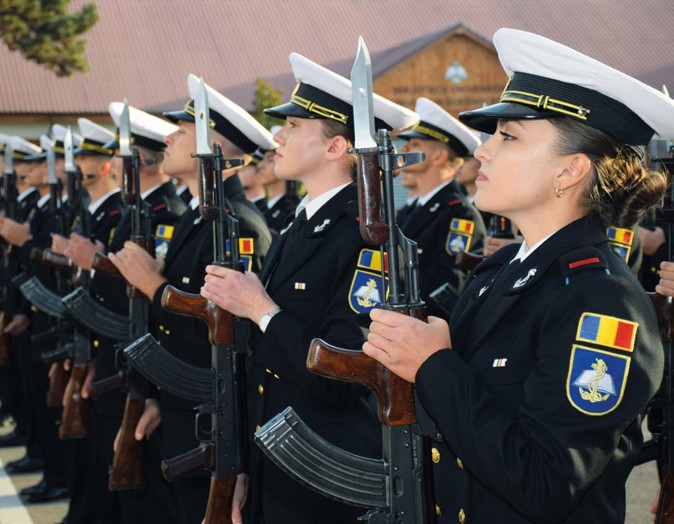
The new campus is designed to meet the highest standards of contemporary military education, offering facilities tailored both to academic activities and to physical and tactical training.
Through education, modernisation, and active international engagement, the Romanian Naval Forces are not only adapting to change, but also shaping generations of professionals capable of protecting Romania’s interests in an increasingly complex geopolitical environment.
