

Lieutenant General Ciprian Marin,
Chief of the Romanian Land Forces
This is the time for transformational leaders in order to become the modern and ready-to-fight force that we want
and need to be!
he time we live is full of challenges. Therefore, we focus our efforts on force preparation, increased competitiveness, and the development of innovation within the Romanian Land Forces. The results we achieved on multiple functional areas during the last two years have set the foundation for the next stage – the experimentation and capitalization of initiated processes.
The attrition of the wars we witness have confirmed the importance of the human factor in operations. Consequently, physical and psychological resilience becomes essential in facing the challenges of the battlefield.
I strongly believe – and act accordingly – that the starting point to see progress is to render an utmost attention to the young generations and leaders. Military leadership involves decision-making under critical conditions, which entails risks, some of them major.Therefore, we develop the Land Forces’ spirit by encouraging open-minded people to confront resistant mentalities to change. We are promoting initiative, stimulating the personnel to come up with new solutions and ideas. Thus, progress and positive results have started to show up. Success proves to favor those with initiative, who assume risks, and adapt rapidly to the situation.
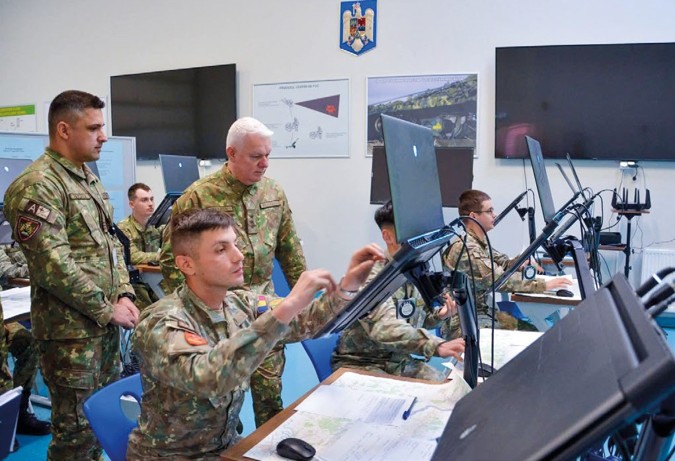
We started to reform education and leadership culture by promoting mission command philosophy, reducing rigid hierarchies, fostering initiative, improvisation and adaptability. We all need to empower junior officers and NCOs to make decisions. Everything is possible by modernizing curricula at military schools and academy.
From the research conducted within the military education system, to the validation of new combat procedures and the development of training infrastructure, innovation is present across various domains at all levels of command.
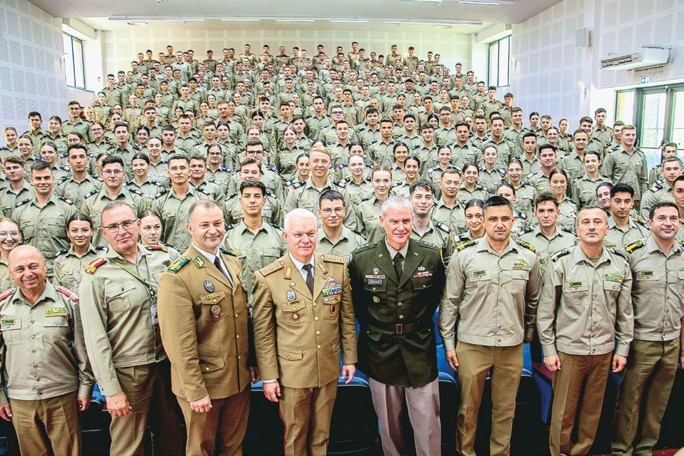
A highlight on this line of effort is to find the right people, with proper skills. Therefore, the education we provide from the military high school up to the Land Forces Academy and the following military training are key functions under improvement. We ensure proper integration within the land forces and develop the winning mindset for the newly integrated young personnel.
In 2025, we achieved the best results out of the last 7 years, in terms of number of youngsters admitted to various forms of the land forces’ military education system. These numbers must be sustained by a continued effort to develop the infrastructure and facilities from military education institutions and training centers.
A successful education of the junior officers, warrant officers, non-commissioned officers and volunteers depend on each of us, commanders and comrades alike. We are responsible to wisely assist, integrate, harden and convince them that they didn’t chose just a profession, but a way of life.
Promoting grit, character and willingness for professional excellence, along with creating conditions for the development of their own personal traits represent main vectors for increasing our combat capability.
Another line of effort is the development of training assets and methods, capitalizing on experience gained in missions, multinational exercises, cooperation with allies and partners, lessons learned, and best practices. We are building training facilities to ensure accurate replication of conditions specific to the current operational environment.
We are interested in and are looking for projects that may support us in continuing the development of the training infrastructure, properly equipped training fields, firing ranges, urban training, air assault, and so on.
Interoperability is another key lesson. We will most likely operate as part of a coalition. We saw that interoperability between NATO allies is not as seamless as we’d like. Whether it’s ensuring that different nations use same munitions, integrating command-and-control systems, or having a shared operational picture, we need to build systems that allow our forces to fight as a truly unified team. Real progress comes from cooperation. We are a reliable NATO and EU ally and regional security contributor in the Black Sea area and Balkans.
We conduct complex multinational exercises, to increase the interoperability with allies and partners, integrating the newly introduced types of equipment. We benefit from the chance to have foreign troops deployed to
Romania. Common drills, standardized communication and information systems and protocols, searching for logistics integration with allied forces play a critical role on interoperability.
 Civil-military integration and support in crises (such as disaster relief) should be another key focus action. True societal resilience is multi-nodal. It depends not just on a strong state, but on the collaborative strength of an informed, prepared, and empowered society. Ukraine’s model demonstrates that distributed decision-making, community ownership, and cross-sector alliances are strategic assets.
Another action we take is to provide troops with modern equipment and technologies. The procurement programs we have started allow us to accelerate the modernization efforts, to get the capabilities required by the evolving security challenges. These will improve our readiness and employability.
 Major procurement programs are currently oriented towards the synchronized and integrated development of all war-fighting functions: command and control, ISR, maneuver, fires, combat service support, force protections and CIS with the proper capabilities, in accordance with the new NATO force model. At present, all combat functions are supported by ongoing or planned acquisitions in the coming years.
Acquiring modern military equipment is not a sufficient condition for the development of relevant defense capabilities. The capability of supporting it throughout its life cycle, both in peacetime and in crisis or war, is essential. Thus, the national defense industry plays a vital role in supporting our needs. Industrial cooperation, is a mandatory measure for the development and consolidation of national production and maintenance facilities.
We live challenging times, so we must be prepared at any moment to overcome them with courage and perseverance. Learning from the past helps, but innovation and adaptation are always required. Embracing technological innovation, proper training and organizational adaptability will lead to operational resilience and facilitate victory.
In a nutshell, we put a lot of effort in building modern and effective land forces adapted to the today’s security environment. We follow a comprehensive and forward- looking strategy. Our key focus areas for developing capable, adaptable, and technologically advanced land forces are: recruitment and retention of skilled personnel for the Army, reform officer and NCO education to match current requirements, focus on leadership development, build modular, flexible unit structures, sustainable, efficient and resilient force structures, PLUS expand training across all domains (land, air, sea, cyber and space), drone operations, electronic warfare and AI.
Without a safe and secure environment, no other priority in life would be possible!
