
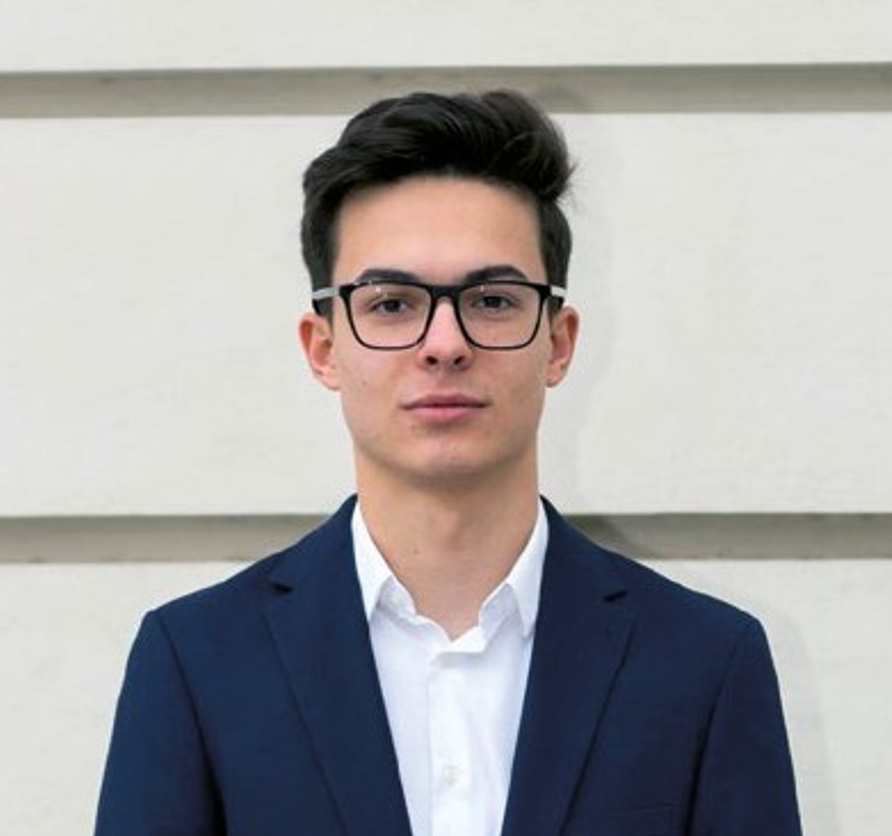
Remarks by
David-Ioan Olaru,
10th Grade, MI Class, Laude-Reut
Educational Complex at the Diplomacy Conference
within the “Bucharest Leaders’ Summit: United for
Better Future” (Bucharest, May 22, 2026)
When you tell someone that you attend a high school where diplomacy is taught as an academic subject, you usually get one of two reactions: a raised eyebrow or the question, “And what exactly do you learn there?” I would like to answer the second question through my own experience as a student at Laude-Reut, the only school in Romania where diplomacy is not an extracurricular activity, but a discipline in its own right.
And since we are speaking about diplomacy, allow me to begin with a brief confession: the most important lesson I have learned so far was not taught at the blackboard. I learned it while sitting behind a long table, with a microphone in front of me, trying to maintain order in a room full of teenagers representing one hundred sovereign states.
I am referring to LaudeMUN, the Model United Nations conference that our school has organized for the past thirteen years. This year, I had the privilege of serving as Deputy Secretary-General, one of the highest leadership positions within the conference. I would like to pause here for a moment, because this experience taught me something that no textbook can truly convey: diplomacy is not about speaking eloquently. It is about listening carefully, anticipating tensions before they become conflicts, and bringing together people who, at first glance, appear to have nothing in common.
As Deputy Secretary-General, I learned that true leadership is not revealed when everything runs smoothly. It becomes visible in the moments when someone raises a concern, or when the logistics of an entire day depend on a single decision made within thirty seconds. I learned to trust my team and, perhaps most challenging of all, to accept that sometimes the best solution is not my own, but that of the colleague sitting beside me. To me, this is the essence of teamwork: setting aside your ego in pursuit of a shared goal. And for a future diplomat, that lesson is worth more than ten courses.
Yet LaudeMUN is not the only environment in which our school prepares us for the world of diplomacy. Every year, the school organizes 2Day Ambassador, a conference that brings together themes such as diplomacy, innovation, and the future, and in which I also had the opportunity to participate this year. As part of the event, students compete in a public speaking contest where each participant represents a country and delivers a speech on a topic related to the future and diplomacy. Preparing for such a competition compels you to think like an ambassador rather than a student: to research the interests of a nation that is not your own, to understand its sensitivities, and to defend its positions even when they differ from your personal beliefs. It is an exercise in empathy that few adults ever have the opportunity to practice.
As we look around us—at the religious divisions that separate communities, the political differences that consume entire societies, and the social tensions that seem to intensify with each passing day—it becomes increasingly clear that diplomacy is emerging as one of the fundamental skills of the century ahead. My generation will inherit a world in which the ability to engage in dialogue with those who are different from us will no longer be optional; it will be essential.
A student who learns at the age of sixteen how to negotiate a resolution, mediate a conflict, and represent a position that is not his own becomes, fifteen years later, an adult capable of engaging in genuine dialogue in a world filled with noise. And we need such adults now more than ever.
The future speaks many languages, and our responsibility is to learn how to listen to them all.
