
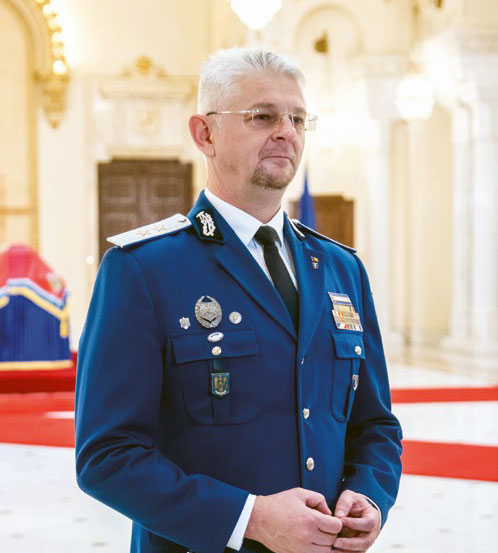
After 168 years, Grigore Alexandru Ghyka (1807–1857)—the last Prince of Moldavia and founder of the Romanian Gendarmerie— has returned to his homeland. His remains were repatriated from France, from the town of Le Mée-sur-Seine, where he had been buried following his death in 1857.
The commemorative ceremonies took place between 7 and 12 November 2025, following an itinerary through Bucharest, Focșani, and Iași, where the Prince was ultimately reinterred. The event was made possible through the efforts of the Romanian Gendarmerie and the Ghyka Family, with the support of local authorities and partner institutions.
Grigore Alexandru Ghyka ruled Moldavia from 1849 to 1853 and again from 1854 to 1856. A visionary statesman and reformer, he championed liberty, justice, and the common good, placing public interest above personal gain while promoting modern principles of governance and social equity.
During his reign, a number of landmark reforms were introduced, including the emancipation of the Roma population, the abolition of censorship, and the reduction of commercial taxes. His legacy is also closely associated with the establishment of the Romanian Gendarmerie in 1850, modeled on the French system, as well as the creation of the country’s first public maternity hospital, the Gregorian Institute, financed from his personal resources.
November 7th – Le Mée-sur-Seine flight to Bucharest The religious ceremony for the exhumation of Prince Grigore Alexandru Ghyka’s remains took place at the cemetery in Le Mée-sur-Seine, France.
Among those present were members of the Ghyka family, Her Excellency Ioana Bivolaru, Ambassador Extraordinary and Plenipotentiary of Romania to France, Lieutenant General André Petillot, Deputy Director General of the French Gendarmerie, Major General Frantz Tavart, Commander of the French National Gendarmerie Military Academy, and Major General Cătălin Stegăroiu, First Deputy Inspector General of the Romanian Gendarmerie.
Another ceremonial event was held at the French National Gendarmerie Military Academy, where the French Republican Guard paid military honors to the Prince. His coffin was placed on the academy’s main parade ground, carried jointly by French gendarmes and members of the Romanian Gendarmerie’s Honor Guard. The coffin was flown to Romania on 7 November aboard a TAROM flight. Upon arrival, it was received with military honors and taken to the Chapel of the Church of Saints Michael and Gabriel at the headquarters of the Romanian Gendarmerie Inspectorate General.
November 8th – Chapel of Saints Michael and Gabriel, Romanian Gendarmerie Headquarters
On the feast day of Saints Michael and Gabriel, the spiritual patrons of the Romanian Gendarmerie, a memorial service was celebrated for Prince Grigore Alexandru Ghyka at the Gendarmerie church.
The service was officiated by His Grace Bishop Varlaam Ploieștianul, Patriarchal Vicar Bishop, in the presence of the Prince’s descendants, Romania’s Minister of Culture, András István Demeter, representatives of the French Embassy in Romania, and senior officials of the Romanian Gendarmerie.
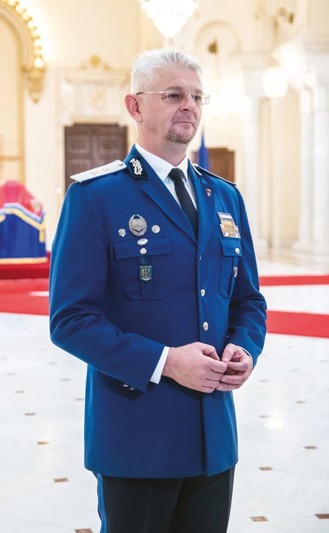
On this occasion, Major General Alin Mastan, Inspector General of the Romanian Gendarmerie, emphasized the historical significance of the event: “The repatriation of Prince Ghyka is not merely a symbolic act; it is a genuine act of historical recovery, a return to our spiritual and institutional roots.
For the Romanian Gendarmerie, this moment carries profound significance. It marks the homecoming of the man whose reforms, vision of governance, and devotion to the rule of law directly and indirectly inspired the values that continue to define us today: honor, discipline, and service to the public good.
Prince Grigore Alexandru Ghyka was both a man of his age and ahead of it. He understood that order and respect for the law are not merely instruments of governance but expressions of civilization itself. Guided by these convictions, he promoted strong institutions and laid the foundations for structures capable of ensuring social peace and protecting the dignity of the citizen. Through this legacy, his vision remains embedded in the very mission of the Romanian Gendarmerie.”
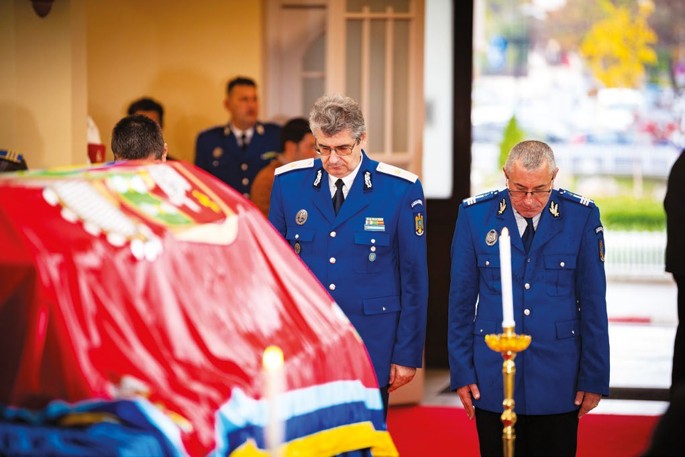
November 9th – The Unification Hall, Cotroceni Palace As a mark of deep respect for the memory of the last ruler of Moldavia, President Nicușor Dan ordered that the coffin containing Prince Ghyka’s remains be placed in the Unification Hall of Cotroceni Palace on Sunday, November 9th 2025.
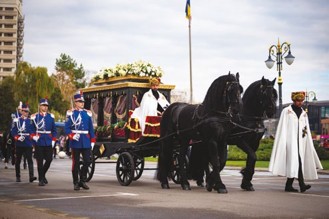
Escorted by eight mounted pairs from the Romanian Gendarmerie, the funeral cortege arrived at the Presidential Palace around 10:00 a.m., where the coffin was placed on a ceremonial catafalque. At noon, President Nicușor Dan delivered a tribute speech:
“Today, through the honors accorded to a head of state, we acknowledge the dignity of our history before the emergence of the unified Romanian nation-state. We honor the role played by the political leaders of that era in fulfilling the national ideal. I am convinced that we can now begin to view our past with greater serenity and fairness, drawing from it the most valuable lessons for the future. Welcome home, Your Highness.”
Major General Alin Mastan followed with remarks thanking the President for hosting the remains at Cotroceni Palace and highlighting the Prince’s contributions to Moldavia and to the establishment of the Romanian Gendarmerie: “Under his reign, Moldavia underwent profound transformations, including in the field of public order. For the Romanian Gendarmerie, the repatriation of Prince Grigore Alexandru Ghyka represents not only an act of historical restitution but also an expression of deep respect for our institutional origins.
He understood better than anyone that order, law, and dignity form the foundation of a modern state. Those same principles continue to guide our mission today as Romanian gendarmes, striving daily to serve the nation with faith, honor, and devotion. Today through this solemn act, Romania recognizes and honors one of its great nation- builders. Grigore Alexandru Ghyka returns home, and with him a part of our historical consciousness is restored.”
November 10th – Cotești Manor, Union Square and the Vrancea Museum, Focșani
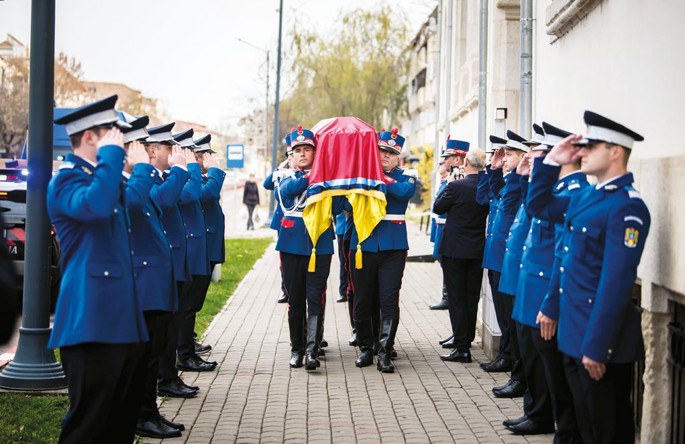
On November 10th, the coffin was first taken to Cotești Manor, the ancestral estate of the Ghyka family, for a private commemorative gathering. At 2:00 p.m., the cortege arrived in Union Square in Focșani, where military and religious ceremonies were held in honor of the Prince. The event featured the Romanian Gendarmerie’s Honor Guard and its battle flag.
Representatives of local and county authorities, members of the Romanian Gendarmerie, the Romanian Orthodox Church, the Ministry of Internal Affairs, and the Ministry of National Defence attended the ceremony.
The solemn atmosphere was enhanced by the ceremonial music of the Romanian Gendarmerie band. Mounted gendarmes accompanied the funeral procession, lending additional dignity and distinction to the occasion. Besides himself, the Romanian Gendarmerie horses were present which accompanied the funeral procession during the ceremonial route thus providing a note of distiction for the event.
Following the ceremony, the cortege proceeded along Unirii Boulevard, Republicii Street, and Cuza Vodă Street to the Vrancea Museum, where the coffin was placed on a catafalque and made accessible to the public for floral tributes and expressions of respect.
Brigadier General Engineer Lucian Trășcălie, Deputy Inspector General of the Romanian Gendarmerie, addressed those gathered: “We stand here today to receive, with respect and gratitude, the earthly remains of Prince Grigore Alexandru Ghyka, the last ruler of Moldavia, a man who loved this land, this people, and this country with rare devotion. Focșani marks his first stop on Moldavian soil— the land he served with faith and vision, the land he carried in his heart even when circumstances forced him away from it. It is no coincidence that this moment takes place in Union Square, a symbol of national consciousness, where the border between Moldavia and Wallachia was transformed, through the will and sacrifice of our forebears, into a bridge of unity.”
November 12th – Palace of Culture, Iași
On Wednesday, 12 November, the funeral vehicle arrived in Iași’s Union Square. In front of the Museum of the Union, the coffin was transferred to a horse-drawn hearse and carried along Ștefan cel Mare Boulevard to the Palace of Culture. There, the Prince was received with military honors befitting a head of state.
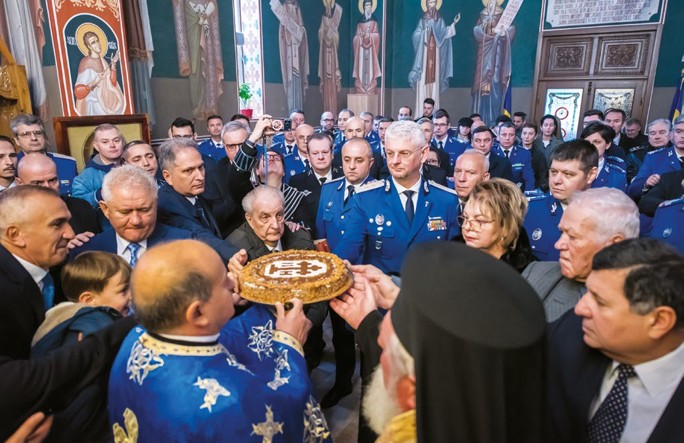
After the coffin was placed in the central hall of the Palace of Culture, representatives of the Metropolis of Moldavia and Bukovina conducted a religious service. Present for the ceremonial were descendants of the Prince, Minister of Investments and European Projects Dragoș Pîslaru, representatives of the Romanian Gendarmerie, the Ministry of Internal Affairs, the Ministry of National Defence, and local authorities.
Major General Cătălin Stegăroiu, First Deputy Inspector General of the Romanian Gendarmerie, stated: “After a long journey through time, the Prince returns to where he belongs—home, to the land he loved and served with dignity and courage. His coffin rests here in the Palace of Culture in Iași, a place of profound symbolism—a temple of beauty and Romanian spirit, a landmark of our cultural identity. It is only fitting that this house of light, built upon the foundations of history, should become, if only for a moment, a place of remembrance and tribute to a great ruler, a man of ideals, a patron of culture, and a defender of national values.”
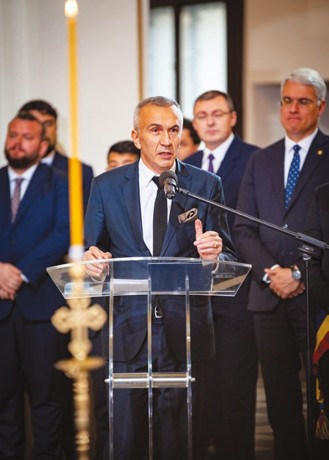
Speaking on behalf of the family, Mihai Ghyka reflected on the broader significance of the occasion: “Today we are revisiting the history of the Principalities and of Romania itself. After 1989, we reexamined the period following Alexandru Ioan Cuza, as the Kings of Romania had long been forgotten, overlooked, or diminished. The time has now come to remember those who prepared the Principalities for the Union that we desired so deeply. We look to the rulers of Moldavia and Wallachia who believed in that ideal and laid its foundations. The gesture we make together today has been the aspiration of our family for many years. It is also a sacrifice—a gift offered by the family to the nation: returning the Prince of Moldavia to the country he loved so dearly.”
The repatriation of Prince Grigore Alexandru Ghyka’s remains represents far more than a ceremonial act. It is a gesture of moral restitution and a tribute to an exceptional historical figure. In bringing him home, Romania symbolically reunites its past with its present, honoring a visionary ruler who dedicated his life to the modernization of society in the name of freedom, justice, and national dignity.
