
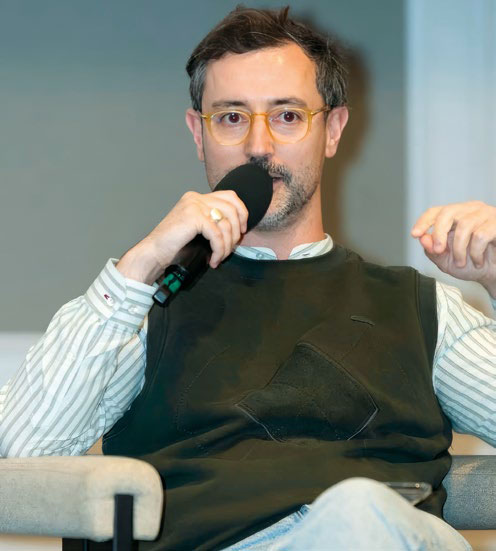
Dragoș C.-L. Preda Vice President Business Development Europe – ActiveWatch Security, Former Minister State Secretary for Telecommunications, Romania
Former CEO, RADIOCOM
How the “Omni-Use” Era Is Transforming the Global Economy and Redefining the Europe-India Strategic Axis
Editorial Introduction
In the twentieth century, technology was divided between civilian and military applications. In the twenty-first century, that distinction is disappearing.
Artificial intelligence, drones, semiconductors, and autonomous systems are simultaneously shaping global economic productivity, digital infrastructure, and strategic security.
This is the new reality: the era of omni-use technologies.
From Dual-Use to Omni-Use
The concept of dual-use dominated global technology policy throughout the Cold War. Certain technologies: satellites, advanced materials, electronics, could serve both civilian and military purposes.
This model was appropriate in an industrial world where innovation ecosystems were relatively compartmentalized. Today, however, technology evolves in a fundamentally different way.
Artificial intelligence optimizes healthcare systems and global logistics chains while also enabling autonomous defense systems. Drones used in agriculture or infrastructure inspection can rapidly be repurposed into tactical platforms. Semiconductors: the foundation of all digital technologies, power both smartphones and satellites, as well as advanced military systems.
The dividing line between civilian and military domains no longer meaningfully exists.
We are now entering the age of omni-use technologies: systems capable of generating economic value, industrial transformation, and strategic power simultaneously.
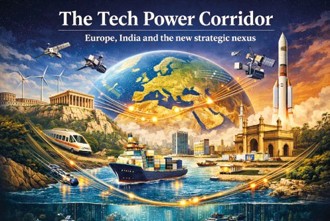
The Silent Revolution of Technological Convergence Artificial intelligence, semiconductors, and drones are reshaping the global economy
Over the past decade, the world has witnessed an unprecedented acceleration of technological convergence. Artificial intelligence is optimizing industrial processes, detecting financial fraud, managing critical infrastructure, and enabling autonomous defense systems.
Semiconductors: the backbone of all modern digital systems, underpin smartphones, data centers, satellites, and advanced military platforms.
At the same time, the global drone market perfectly illustrates this transformation.
Originally developed for military reconnaissance, drones have become indispensable tools across multiple economic sectors. Today, they are widely used for:
- precision agriculture monitoring
- inspection of energy infrastructure
- disaster response and emergency operations
- autonomous logistics and transportation
- surveillance and security
Meanwhile, the war in Ukraine has demonstrated how relatively accessible commercial platforms can rapidly evolve into tactical reconnaissance or strike systems.
This convergence confirms a fundamental shift: emerging technologies can no longer be neatly categorized as civilian or military. They are becoming universal technological infrastructures of the global digital economy.
A New Geography of Innovation: The Rise of Asian Technology Ecosystems
India and South Asia as emerging technological power centers
Alongside technological convergence, a new geography of global innovation is taking shape.
Where innovation ecosystems were once concentrated in North America and Europe, India and South Asia are now emerging as major actors in the global technology economy.
The region combines three decisive structural advantages:
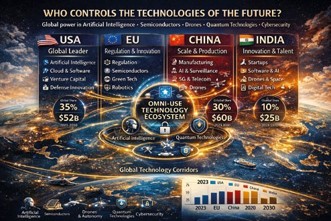
- a population exceeding three billion people
- rapidly expanding digital infrastructure
- public policies oriented toward technological innovation and industrialization
A particularly relevant example is the set of programs developed under India’s Defence Acquisition Council (DAC) 2025–2026 framework.
These initiatives aim to accelerate technological development in areas such as:
- artificial intelligence
- autonomous systems
- drones
- cybersecurity
- space technologies
- advanced sensing systems
What distinguishes these programs is their integrated approach.
Rather than treating emerging technologies exclusively through a military lens, the DAC framework connects the defense industry with startup ecosystems and technological universities.
The result is the emergence of a cross-sector innovation model, in which technologies are developed simultaneously for economic, industrial, and strategic applications.
Europe Between Fragmentation and Strategic Opportunity
In this rapidly evolving global environment, Europe faces a structural challenge.
Its institutional architecture was designed in an era when the separation between civilian and military domains was clearer. Industrial policy, security strategies, and innovation programs are often developed within separate institutional frameworks, limiting strategic responsiveness.
At the same time, other global powers are building integrated technological ecosystems.
The United States aligns private capital, research, and defense programs through initiatives such as the CHIPS and Science Act. China promotes civil-military technological integration. India is developing a hybrid model combining public digital infrastructure with a dynamic startup ecosystem.
For Europe, the challenge is clear: adapting technology governance to the realities of global convergence.
A Strategic Opportunity: The Europe-India Technology Partnership
In this context, cooperation between Europe and India is gaining strategic importance.
The launch of the EU-India Trade and Technology Council (TTC) provides a framework for collaboration in key areas such as:
- semiconductors
- artificial intelligence
- secure digital infrastructure
- resilient supply chains
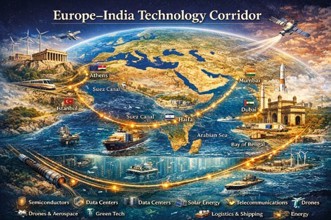
At the same time, the India-Middle East-Europe Economic
Corridor (IMEC) has the potential to evolve beyond a logistical initiative into a global technology corridor.
Such a corridor could connect innovation ecosystems across Europe, the Middle East, and South Asia, enabling the development of new industrial and technological value chains.
A Strategic Choice for Europe
The twenty-first century will be defined by the ability of states to rapidly adapt and redeploy technologies across multiple domains.
Artificial intelligence, semiconductors, autonomous systems, and advanced manufacturing no longer belong to separate sectors. They form interconnected technological ecosystems, where economy, security, and innovation evolve simultaneously.
The concept of omni-use captures this reality.
For Europe, embracing this perspective could unlock new opportunities for strategic cooperation: particularly with emerging ecosystems in India and South Asia.
In a world shaped by technological competition and accelerating geopolitical transformation, the ability to build such partnerships will be essential to Europe’s economic resilience, strategic autonomy, and global influence.
Author Profile
Dragoș C.-L. Preda is currently Vice President for Business Development Europe – ActiveWatch Security, and former Minister State Secretary for Telecommunications of Romania. He previously served as CEO of the National Radiocommunication Company (RADIOCOM), where he led the modernization of Romania’s strategic communications and broadcast infrastructure.
With nearly two decades of experience at the intersection of technology, public policy, and digital security, he is actively involved in international initiatives on emerging technology governance, digital infrastructure, and strategic technological cooperation.
His work focuses on the geopolitical implications of technological convergence and on building strategic bridges between innovation ecosystems in Europe, Asia, and the Middle East.
