
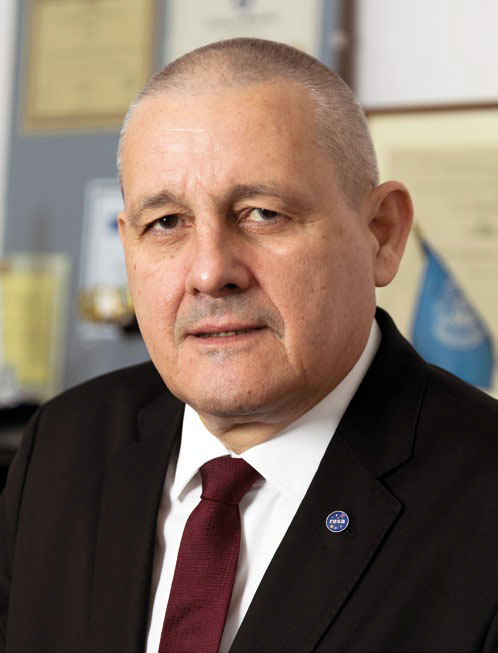
Eng. Marius-Ioan Piso, PhD Vice President of the International Academy of Astronautics
The International Academy of Astronautics (IAA) was founded by space pioneers in 1960 as an international non- governmental organization. Its purpose is to promote the development of astronautics and international collaboration, by admitting prominent personalities as members, by conducting medium and long-term programs, organizing conferences and symposia, as well as by providing the highest level of consultancy to governmental and international institutions and bodies in the space field. The Academy is a permanent observer at the United Nations, within the Committee on the Peaceful Uses of Outer Space (COPUOS).
Currently, the Academy brings together the skills of more than 1,100 full and corresponding members from 90 countries, chosen through a rigorous process involving recommendations, referees and secret ballot. After a period of five years, the corresponding members must prove their excellence and suitability for the organisation’s objectives in order to obtain full membership.
The IAA is structured in four main sections: 1. Basic Sciences; 2. Engineering Sciences; 3. Life sciences in space;
- Leadership & Social Sciences
These sections cover the entire spectrum of specialists: scientists, builders of space systems, astronauts, experts in life in space, heads of space agencies, lawyers, artists and journalists.
One of the central activities of the Academy is the development of study groups, which develop comprehensive synthesis works on relevant topics. These studies go through a rigorous peer-review process and are published under the aegis of the IAA. Currently, more than 75 completed studies can be accessed for free on the official website of the Academy: www. iaaspace.org. The studies are coordinated by the Committee for Scientific Activities (SAC) and are divided into the following committees:1. Physical Sciences2. Life Sciences3. Space technologies and systems4. Space operations and uses5. Strategies, Space Law and Economics6. Society, culture and education
The IAA organizes between 30 and 35 global conferences annually, held on all continents, with constantly evolving topics. Significant events in 2024 and 2025 include:• 4th IAA Conference on Space Situational Awareness (ICSSA) – Daytona Beach, USA, May 8–10, 2024• 1st IAA Symposium on Artificial Intelligence Technologies for Space – Xi’an, China, September 8–9, 2024• 75th International Astronautical Congress (IAC) – Milan, Italy, October 14–18, 2024• 11th Space Traffic Management Conference – Austin, USA, Jan– Feb 2025• 9th IAA Planetary Defense Conference (PDC) – Stellenbosch, South Africa, 5–9 May 2025• 15th IAA
Symposium on Small Satellites for Earth System Observation – Berlin, Germany, May 2025• 76th International Astronautical Congress (IAC) – Sydney, Australia, 29 September–3 October 2025• IAA Space and Society Conference – Timisoara, Romania, 2026 (tbd)
A particularly important tool of the IAA is the scientific journal
*Acta Astronautica*, launched in 1961. The magazine, now operated by Elsevier, has seen a steady increase in prestige. Today, it has an impact factor of 3.8, and the number of downloads exceeds two million annually. The editorial coordination on behalf of the IAA is provided by a Romanian vice-president.
România is well represented within the Academy, with nine full Romanian members and one honorary member. Two of them are members of the Board of Trustees, one of whom serves as vice president.
A remarkable success of Romania in the last two decades is the coordinated study: *Space Systems as Critical Infrastructure*. Initiated in 2008 by Marius-Ioan Piso, the study evaluated the dependence of modern society on space systems (satellites and terrestrial infrastructure). This effort predated NATO’s *One Day Without Space* initiatives and anticipated later developed legislation in the EU and the US. The project was accompanied by the organization of 11 annual conferences in Romania, and the results were published by the IAA and in volume by Springer. The conclusions of the study contributed significantly to the elaboration of the national legislation on critical infrastructures, where the field of space is clearly defined by government decision.
Another important area in which Romania has a constant contribution is planetary defense. The second edition of the IAA *Planetary Defense* conference was organized in Bucharest, in the Palace of Parliament, in 2011. The person responsible for this area on behalf of the IAA is also a Romanian member.
Mr. Marius-Ioan Piso, member of the IAA since 2004, after a journey through the stages of full member and study leader, was elected head of the 4th section of the IAA. In 2019 he was proposed by the nominating committee and elected by a large majority as vice-president for scientific activities, being re-elected in 2021 (maximum two terms). In 2023 he was proposed and elected vice president for publications and communication, a position that gives him, among other things, the responsibility on behalf of the IAA for the journal
*Acta Astronautica*. Starting with 2023, the representative and head of the IAA delegation to the UN – the Committee on the Peaceful Uses of Outer Space (COPUOS) – is appointed.
The International Academy of Astronautics is an elite scientific community, bringing together personalities from more than 90 countries – 46 of which are represented by one or two members. It is a powerful example of a global organization of the *soft power* type. Romania’s active and constant participation in the IAA, for over two decades, contributes significantly to strengthening the national position in a field with the fastest growth worldwide.
