
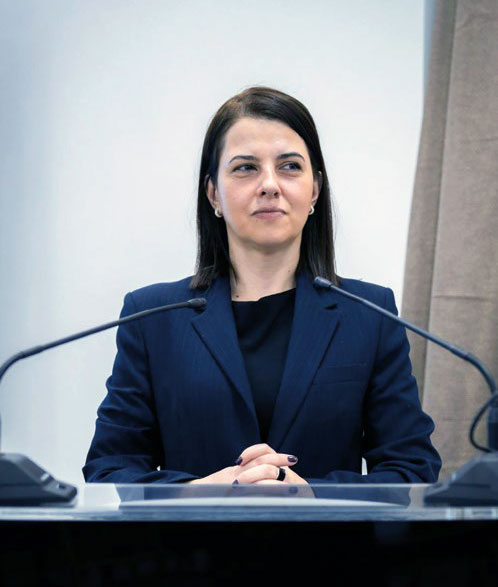
Police Chief-Quaestor Ramona Dabija,
Director at the Ministry of Internal Affairs
Few criminal phenomena have evolved as rapidly as the synthetic drug market. In recent years, this category of substances has fundamentally transformed both the operating methods of organized crime groups and the strategies that governments are compelled to adopt in response to a threat that is constantly evolving.
Unlike traditional drugs, which depend on agricultural cultivation, established trafficking routes, and complex logistical chains, synthetic drugs can be produced quickly in clandestine laboratories located virtually anywhere that chemical precursors and technical expertise are available. Low production costs, operational flexibility, and the ability to continuously modify chemical compositions provide criminal networks with a significant advantage over traditional control mechanisms.
The primary challenge for authorities is not merely the volume of substances circulating on the market, but rather the speed at which new chemical compounds emerge. In many cases, by the time a new substance has been identified, analyzed, and added to controlled-substance lists, another has already entered the market. Under these circumstances, combating synthetic drugs has become a continuous race between the ability of governments to anticipate developments and the speed with which organized crime adapts.
The phenomenon is further amplified by digitalization. Encrypted communication platforms, secure messaging applications, social media networks, and courier services have redefined drug distribution methods. Direct contact between traffickers and consumers is often eliminated, with the entire process taking place in an environment that offers a high degree of anonymity and creates additional challenges for investigative activities. The financial engine of these markets is represented by virtual currencies such as Bitcoin and Monero, which eliminate the need for cash transactions or conventional bank transfers, making financial flows significantly more difficult for authorities to trace.
In this context, the development of modern detection and control capabilities has become a strategic necessity. The deployment of high-performance mobile scanners has significantly enhanced the ability of law enforcement agencies to identify suspicious shipments and conduct effective inspections of vehicles, containers, parcels, and other means used to conceal illicit substances. These systems enable rapid and accurate inspections, reduce vulnerabilities exploited by traffickers, and improve operational efficiency at border crossings and major logistics hubs.
Equally important is the work of specialized canine units trained to detect high-risk and particularly dangerous narcotics. While technological progress is essential, operational experience consistently demonstrates that canine resources remain among the most effective methods for identifying illicit drugs. The ability of service dogs to detect even trace amounts of narcotics, including in cases involving sophisticated concealment techniques, provides a significant operational advantage that effectively complements modern technical capabilities. The integration of canine units into operational deployments directly contributes to higher detection rates and more efficient operations at airports, seaports, border crossing points, and logistics centers.
At the same time, monitoring drug transactions on the Darknet provides valuable insights into the scale of online drug trafficking and the associated health and security risks. This activity relies on automated software tools, commonly known as web crawlers, which periodically collect data on drug types, prices, quantities, and buyer reviews, the latter often serving as indicators of sales volume. However, the volatile nature of this environment makes long-term trend analysis particularly challenging.
Similarly, the use of specialized blockchain analytics platforms to track illicit financial flows, de-anonymize users, and combat money laundering has become an extremely important tool for law enforcement and regulatory authorities.
Romania faces the same challenges affecting the broader European landscape. Its geographical position at the intersection of major commercial and transportation corridors, combined with its integration into regional and international economic flows, makes the country an area of interest for networks involved in drug trafficking. In this context, strengthening operational capabilities, modernizing control infrastructure, and expanding international cooperation constitute essential elements of the institutional response.
Nevertheless, European experience demonstrates that success cannot be measured solely through seizures, arrests, or criminal prosecutions. Synthetic drugs simultaneously represent a security challenge, a public health issue, and a test of societal resilience. Efforts to reduce supply must be accompanied by effective prevention, education, and public awareness initiatives addressing the risks associated with drug use. Reducing demand remains just as important as combating trafficking.
Another distinctive characteristic of synthetic drugs is their high degree of unpredictability. The composition and concentration of substances frequently vary from one batch to another, while their effects on the human body are often difficult to anticipate. This creates significant health risks for users and places additional pressure on healthcare and public health systems.
In the face of a rapidly evolving threat, adaptability becomes the primary determinant of success. Investments in technology, the development of professional expertise, strengthened international cooperation, and the deployment of modern detection tools—including mobile scanners and specialized canine units—are essential components of an effective response. The fight against synthetic drugs is no longer solely a law enforcement activity; it is a complex undertaking encompassing security, public health protection, and societal resilience, the outcomes of which will directly influence the safety of future generations.
