
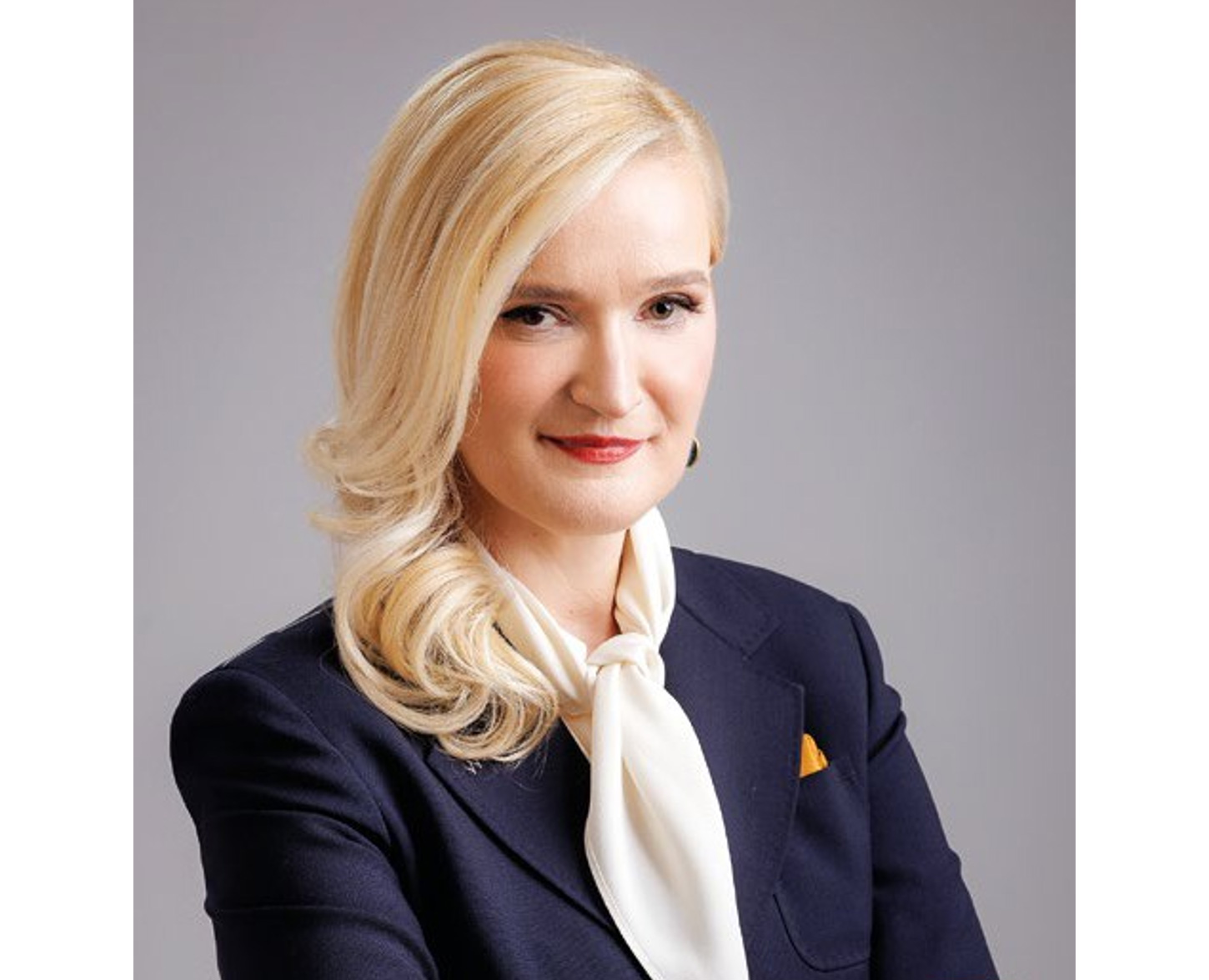
Claudia Griech,
Chief Executive Officer
of E.ON Energie Romania
Few economic sectors have historically been as strongly associated with male leadership as the energy industry. From major utility companies to infrastructure operators, decisions have traditionally been made by male engineers, economists, and executives. Over the past two decades, however, this reality has begun to change. More and more women have risen to leadership positions, demonstrating that performance is not determined by gender, but by professionalism, vision, and the ability to lead complex organizations. Among them is Claudia Griech, one of the most recognized and respected figures in Romania’s energy sector.
Her professional journey differs from that of many industry leaders. She did not build her reputation around large- scale infrastructure projects, nor does she come from the technical side of the energy system. Instead, her career has evolved around customer relations, commercial development, and a deep understanding of how energy influences both people’s everyday lives and business operations.
Claudia Griech joined the E.ON Group, one of Europe’s leading energy companies, in 2005. The experience she gained in various management positions provided her with a broad perspective on a sector undergoing continuous transformation.
Looking back, those years represented a true learning experience. The energy market at the time was very different from the one we know today. Digitalization was limited, competition among suppliers was only beginning to take shape, and consumers had few tools available to manage their relationship with energy providers.
In this context, Claudia Griech was directly involved in developing commercial business segments and modernizing the way the company interacted with its customers. The experience gained during that period would profoundly influence both her management style and her perspective on the future of the industry.
Those who have worked alongside her often describe her as a calm, balanced, and dialogue-oriented leader. In a sector where legislative, economic, and technological changes occur frequently, the ability to build consensus and maintain a clear strategic direction is a significant advantage.
In 2021, Claudia Griech was appointed Chief Executive Officer of E.ON Energie Romania. Her appointment came at a particularly challenging moment. Shortly thereafter, Europe entered one of the most difficult periods in the recent history of the energy sector. The energy price crisis, the uncertainties generated by the conflict in Ukraine, and mounting pressure on energy markets fundamentally changed the rules of the game.
For millions of consumers, energy suddenly became a daily concern. Bills, security of supply, and market outlooks moved to the center of public debate. In such a context, the role of energy companies evolved. Supplying energy was no longer enough. What was needed was communication, transparency, and solutions tailored to a new reality.
This period reinforced one of the convictions that had guided her throughout her career: the future belongs to companies that understand their customers’ needs and build services around them.
Under her leadership, E.ON has continued to expand beyond the traditional energy supply model. The company has invested in photovoltaic solutions, energy efficiency, electric mobility infrastructure, and digital services that enable consumers to monitor and manage their energy consumption more easily.
This approach reflects the profound transformation taking place across the European energy sector. While consumers were once passive participants, they can now become producers, investors, and active partners within the energy system. The rise of prosumers, the development of green technologies, and growing interest in energy independence are fundamentally reshaping the relationship between companies and their customers.
In her public appearances, Claudia Griech frequently emphasizes the need to accelerate investments in networks and infrastructure. Experience from recent years has demonstrated that the energy transition cannot be sustained solely through the installation of new generation capacities. Modern systems capable of integrating renewable energy sources and meeting the demands of an increasingly electrified economy are equally essential.
Another important focus of her work is digitalization. The relationship between energy providers and their customers has changed dramatically in recent years, and technology plays a central role in this transformation. Online platforms, mobile applications, and digital services have become indispensable tools for millions of users.
In her view, technology should never be regarded as an end in itself. Its true value emerges when it simplifies processes, reduces response times, and gives people greater control over their own energy consumption.
Beyond her managerial responsibilities, Claudia Griech has also distinguished herself through her involvement in initiatives that promote diversity and the development of female leadership. In a sector where women remain underrepresented in executive positions, her professional journey demonstrates that performance and authority are built through competence, consistency, and results.
Perhaps it is precisely this combination of international experience, understanding of the local market, and focus on people that explains the respect she enjoys within the industry. In a world where energy is often reduced to figures, installed capacities, and investment volumes, she consistently reminds us that the consumer remains at the center of all these transformations.
After nearly twenty years in the industry, Claudia Griech has become one of the defining figures of Romania’s energy sector. Her work reflects the broader transformation that the industry itself has undergone over the past two decades: from traditional energy supply to integrated services, from conventional customer relationships to digital solutions, and from passive consumption to active participation in the energy transition.
In an industry where infrastructure, technology, and investment are essential, her contribution has been to ensure that people remain at the center of decision- making. And that may well be one of the most important transformations taking place in European energy today.
