

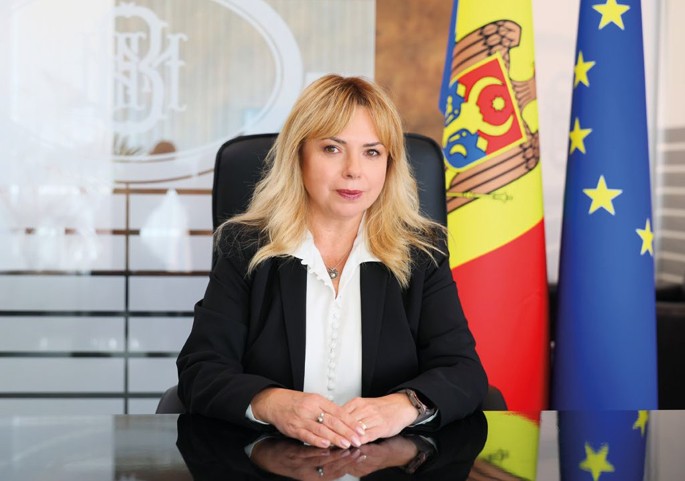
Anca Dragu,
Governor of the
National Bank of Moldova
Thirty-five years is long enough to see patterns. The National Bank of Moldova was founded in 1991, in the middle of a transformation that left nothing untouched – not the currency, not the financial system, not the most basic assumptions about how an economy works. We have since navigated hyperinflation, systemic banking instability, a major financial fraud, a pandemic, and a war on our border. Looking back from 2026, what strikes me most is not the distance we have covered, but the conditions under which we covered it – and what those conditions reveal about the kind of institution the National Bank of Moldova has had to become.
The National Bank of Moldova (NBM) was founded in 1991, in the same breath as Moldovan independence itself. In 1993, the Moldovan leu was introduced, while NBM built a supervisory framework, and entered the global financial system without reserves, without an established capital market, and without a stable banking sector. The National Bank of Romania (NBR) supported our first steps and has remained our closest institutional partner and mentor ever since.
What followed were three decades that tested every capacity we possessed: the hyperinflation of the 1990s, chronic banking instability, the devastating banking fraud of 2014, a global pandemic, and – on our eastern border – a war that reshaped the energy and geopolitical landscape of our entire region. Our historical dependence on Russian natural gas was not merely an economic liability; it was a geopolitical instrument wielded against us with deliberate effect. This context provides the framework for understanding what the National Bank of Moldova has achieved—and what still remains to be done.
In October 2022, Moldova recorded an annual inflation rate of 34.6%. That figure represents more than a macroeconomic statistic – it captures the vulnerability of households watching their purchasing power erode week by week, the paralysis of businesses unable to plan beyond the immediate horizon, and the profound limitations of any central bank operating in a small open economy with constrained instruments to absorb imported price shocks.
The path back was neither swift nor painless. Monetary policy decisions were rigorous, sometimes deeply unpopular, and calibrated with exceptional precision at every step. We could not afford the luxury of imprecision. By early 2026, we had returned annual inflation to within our target corridor of 5%, with a tolerance corridor of ±1.5 percentage points – a result that reflects years of disciplined commitment to a credible nominal anchor and the institutional willingness to absorb short-term discomfort in the service of long-term stability.
The conflict in the Middle East has introduced a new and significant external shock to global commodity markets. By April 2026, annual inflation had risen again to 6.77%. Our response was swift and unambiguous: on 7 May 2026, the Executive Committee of the NBM raised the policy rate from 5.00% to 6.50% per annum. Vigilance remains our permanent operating posture, not a temporary stance adopted in moments of crisis.
A banking sector that has become a strategic asset
Alongside price stability, we constructed something that deserves to be called – without exaggeration – one of Moldova’s most tangible competitive advantages: a sound, well-capitalised, professionally governed, and increasingly internationalised banking sector.
The figures, as of April 2026, speak with notable clarity. The capital adequacy ratio of the Moldovan banking sector stands at 21.9%, more than double the regulatory minimum of 10% and above the European Union average of 20.2% recorded in the second quarter of 2025. The liquidity coverage ratio reaches 286.2%, nearly three times the regulatory threshold of 100%. Non-performing loans, calculated under IFRS standards, stand at just 1.5% of total credit – among the lowest levels ever recorded in our country, and broadly in line with regional peers. Each of these figures is the result of years of structural reform and supervisory discipline, not a benign accident of circumstance.
Financial intermediation increased significantly over the last two years from 23% to around 29% loans to GDP ratio. Total credit volume grew by 26%, rising from approximately €5 billion in the fourth quarter of 2024 to €6.3 billion in the fourth quarter of 2025 – a result that reflects genuine economic confidence.
Perhaps most significant for potential investors and long- term credibility: approximately 95% of banking sector assets are held by European investors – the European Bank for Reconstruction and Development, Banca Transilvania of Romania, Intesa Sanpaolo of Italy, OTP Bank of Hungary, and ProCredit Holding of Germany, among others. This is the accumulated outcome of years of structural reform, governance improvement, and a supervisory culture that has consistently insisted on transparency and accountability as non-negotiable foundations.
International recognition: the validation of markets
These internal achievements are now being recognized in a broader and more demanding international environment – one where credibility can be only earned through determination and actions. For the first time in its history, the Republic of Moldova has been assessed as a country with a stable and improving sovereign profile with a stable outlook and an expectation for growth acceleration, placing it in the same broad category as several emerging economies in the wider non-EU region of Europe which are pursuing structural reforms and closer integration with the European Union.
– These are not merely symbolic validations, these are clear and deliberate signals to global investors that Moldova’s economic trajectory is both credible and predictable. They lower the cost of sovereign borrowing, attract foreign direct investment on more favourable terms, and provide the kind of market validation that no domestic communication campaign can replicate. They are, in a meaningful sense, the most honest external assessment of where Moldova now stands.
European integration: not a destination, but a direction
Every structural reform we have undertaken at the National Bank of Moldova has been guided by a single strategic compass: alignment with European standards and, ultimately, full European integration. This is a description of the technical and institutional choices that have defined our work for late years, and that produced measurable results in 2025.
Moldova’s accession to the Single Euro Payment Area (SEPA) reduced transaction costs by more than 94% for individuals and enterprises operating across European borders. The financial savings generated already exceed
€8 million – and grow with every transaction processed. The approximate 591,000 SEPA transactions would have cost on average EUR 9.49 million via SWIFT but incurred only EUR 689,000 in fees, resulting so far in EUR 8.8 million in economy-wide savings, while the cost of a European transfer fell from about EUR 20 minimum transaction fee to an average of EUR 1.17.
Our national instant payments system, MIA, now connects over one million users and has been recognised across the region as a model of implementation excellence. Since MIA became operational, over 27 million transactions worth MDL 24.2 billion (EUR 1.2 billion) were processed with about 20,000 acceptance points, in a market with more than 90% of small and medium size enterprises. These are complex technical undertakings. But their significance is ultimately human: they reduce the cost and friction of economic participation for ordinary citizens in ways that compound quietly and powerfully over time.
35 years: a foundation
As a Governor, I am sometimes asked what I am most proud of. My honest answer is not any single metric, however encouraging the data may be. It is the institution itself – the demonstrated capacity of the National Bank of Moldova to absorb shock after shock, to pursue reform after reform under conditions that rarely favoured ease, and to emerge from each test with both its credibility and its independence intact.
Credibility is never declared. It is demonstrated – through decisions taken under pressure, through transparent communication with markets and the public, through the willingness to hold the line at precisely the moments when holding the line is most difficult, and most necessary.
Thirty-five years on, that is the institution Moldova has built. And as we look ahead – to the continuing demands of European convergence, to the geopolitical uncertainties that still surround us, to the legitimate ambitions of a society that has earned every aspiration it holds – we are determined to be equal to what comes next.
