
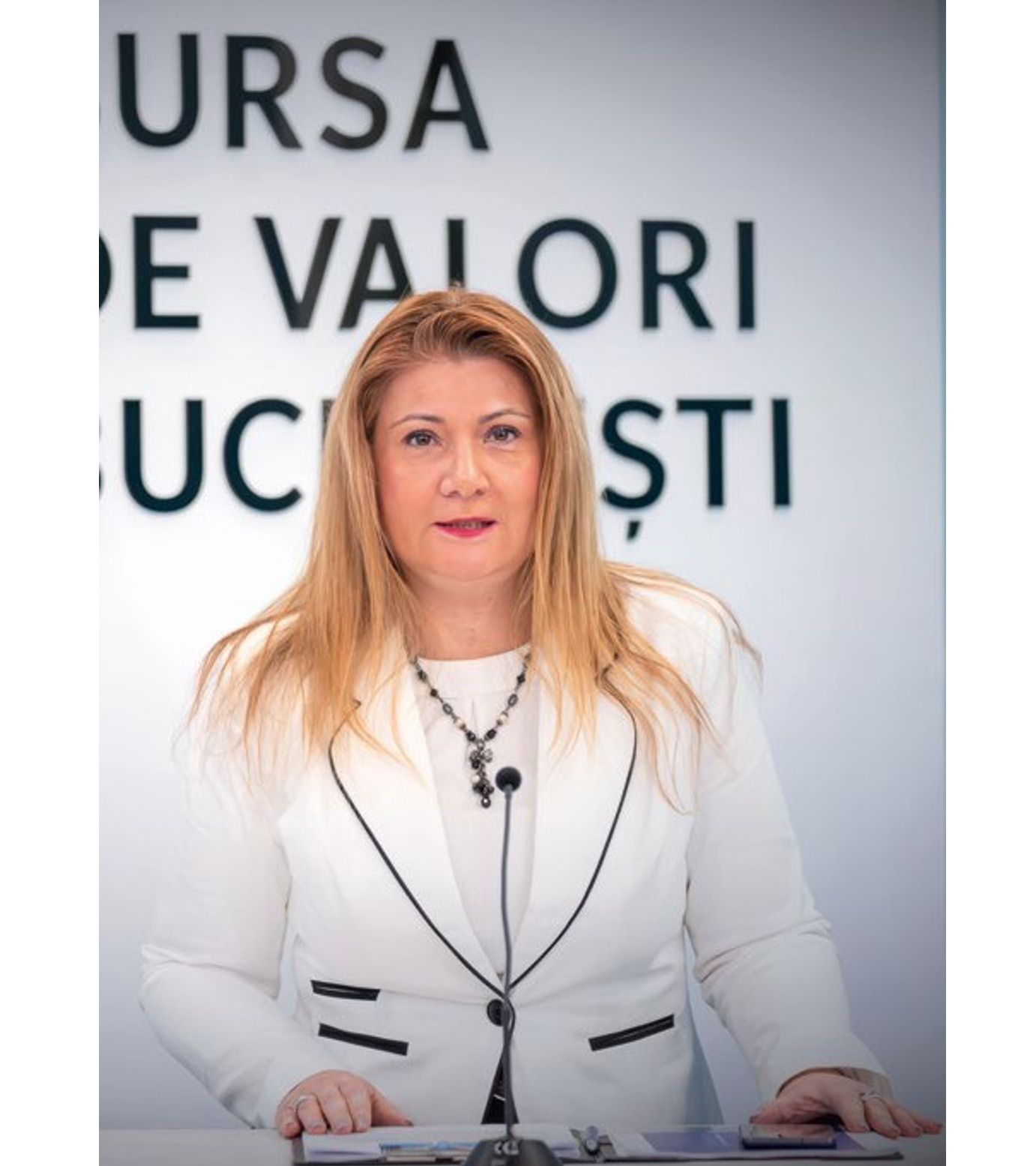
Ileana Botez,
MBA Head of Listing, Bucharest Stock Exchange
& Vicepresident Association for the
Sustainable Development of Businesses
In an economy shaped by continuous transformation, the real challenge is no longer simply building a successful company, but ensuring its ability to endure, evolve, and create sustainable long-term value. Over the past three decades, Romania has undergone a profound economic and institutional transition, while the capital market has played an essential role in this evolution. Beyond figures, transactions, and market indicators, the capital market ultimately represents a space of trust, transparency, accountability, and vision — values without which true competitiveness cannot exist.
Looking back on more than 30 years within Bucharest Stock Exchange, I have had the privilege of witnessing the transformation of Romanian entrepreneurship from the early stages of a developing market economy to the emergence of companies capable of competing successfully at both European and international levels. I have also had the opportunity to contribute directly to the listing of Romanian companies, the development of corporate governance practices, and the advancement of financial education as a strategic pillar of economic development.
One of the most important lessons learned during these years is that business sustainability cannot rely exclusively on financial performance. Profitability matters, but continuity is built through vision, adaptability, responsible leadership, and sound governance. In a world defined by geopolitical uncertainty, accelerated digital transformation, sustainability pressures, and increasing global competition, the companies that will succeed in the long run will not necessarily be the largest, but the ones most capable of inspiring confidence.
Today, corporate governance is no longer merely a regulatory requirement or a compliance exercise. It has become a strategic architecture of resilience.
For many years, governance in emerging markets was perceived as a technical framework applicable primarily to listed companies. Today, we understand that governance is fundamentally about the quality of decision-making, strategic oversight, accountability, succession planning, transparency, and long-term sustainability. It is about creating organizations capable not only of growth, but also of continuity across generations, economic cycles, and disruptive transformations.
Romanian entrepreneurship has matured significantly. We now see ambitious local companies expanding regionally, attracting international investors, accessing sophisticated financing mechanisms, and building strategic partnerships beyond national borders. Yet scaling a company in today’s Europe requires more than entrepreneurial instinct and operational success. It requires institutional strength.
This is where governance becomes a genuine competitive advantage.
Companies with transparent governance structures, professional boards, strategic discipline, and strong ethical cultures are increasingly better positioned to attract investors, financing, strategic partners, and talent. Investors today evaluate not only financial results, but also leadership quality, board effectiveness, risk management capabilities, sustainability practices, and organizational culture.
The international investment environment has fundamentally changed. Capital increasingly flows toward credibility.
Over the past decade, European and global governance standards have evolved considerably. The integration of sustainability principles, ESG criteria, diversity, stakeholder engagement, and long-term value creation into governance frameworks reflects a broader transformation in the way economic success itself is defined. The updated OECD Corporate Governance Principles, together with the growing convergence of European governance frameworks, clearly demonstrate that competitiveness and governance are no longer separate discussions — they are deeply interconnected.
Romania has made meaningful progress in this direction. The capital market ecosystem, regulators, entrepreneurs, investors, and professional organizations have collectively contributed to strengthening transparency and governance standards. Nevertheless, considerable potential still lies ahead.
One of the defining challenges for Romanian businesses over the next decade will be continuity.
Many valuable entrepreneurial businesses remain heavily dependent on their founders, without sufficiently developed succession planning mechanisms, institutionalized management structures, or governance systems capable of supporting sustainable expansion. In many situations, remarkable entrepreneurial energy has built successful companies, but long-term continuity requires institutionalization.
The transition from founder-driven business to resilient institution may become one of the most important strategic transformations for Romanian companies in the coming years.
Boards of directors play a critical role in this evolution. Strong boards bring not only supervision, but also perspective, strategic discipline, diversity of thinking, and long-term vision. They create the framework through which companies can navigate uncertainty, manage risk responsibly, and accelerate transformation in a sustainable manner.
My involvement for more than 25 years in corporate governance initiatives — as a speaker, moderator, mentor, and advocate — has reinforced my belief that governance culture and education are inseparable. Governance cannot exist solely in codes, regulations, or reporting obligations. It must become part of organizational mindset and leadership culture.
This conviction was one of the reasons why, in 2016, within PWN Romania, we developed the first program in Romania dedicated to preparing professionals for board positions. At that time, discussions regarding board professionalism, strategic oversight, and diversity in leadership were still emerging locally. Today, these themes have become central to the future of business leadership.
Preparing future board members ultimately means preparing future custodians of business continuity.
Equally important has been my experience coordinating the financial education program “Fluent in Finance” within Bucharest Stock Exchange since 2015. Through hundreds of seminars, discussions, and educational initiatives involving students, entrepreneurs, professionals, and investors, one conclusion has become increasingly evident: financial literacy is not merely an individual competency — it represents economic infrastructure.
A society that understands investment, governance, risk, and long-term value creation becomes more resilient, more entrepreneurial, and more competitive.
Financial education helps entrepreneurs better understand financing alternatives, encourages companies to access capital markets, supports responsible investment behaviour, and contributes to building trust in economic institutions. In emerging economies especially, trust remains one of the most valuable forms of capital.
Capital markets themselves play a strategic role in strengthening economic competitiveness. Beyond financing, listing on the stock exchange frequently accelerates organizational maturity. Companies become more transparent, more disciplined, more internationally visible, and more accountable toward investors and stakeholders.
For many Romanian companies, the stock exchange can represent not only a financing mechanism, but also a transformation platform.
The listing process often drives companies toward improved governance standards, professionalized management structures, clearer strategic planning, enhanced reporting practices, and stronger market credibility. These elements become increasingly important within the context of European integration and international competition.
Romania possesses the entrepreneurial talent, creativity, and economic potential necessary to develop strong regional champions. However, sustainable competitiveness within the European Union requires long-term thinking, institutional maturity, strategic adaptability, and responsible leadership.
The companies that will shape Romania’s economic future are likely to be those capable of combining entrepreneurial dynamism with professional governance, innovation with responsibility, and growth with resilience.
Recent years have demonstrated how rapidly the global economic landscape can change. The pandemic, geopolitical tensions, inflationary pressures, supply chain disruptions, energy crises, and accelerated technological transformation have all shown that resilience is no longer optional.
Companies need governance structures capable of managing uncertainty, anticipating systemic risks, and maintaining strategic coherence during periods of disruption.
Leadership itself is also evolving. Modern leadership increasingly requires adaptability, integrity, empathy, and the ability to build collaborative organizational cultures. The most successful organizations of the future will not necessarily be those driven exclusively by hierarchy, but those capable of integrating competence, diversity of perspectives, ethical leadership, and long-term stakeholder trust.
Romania stands today at an important moment of economic maturity. The next phase of development will not be defined solely by economic growth rates, but by the quality of institutions, governance standards, education, and strategic vision.
In this broader transformation, the roles of capital markets, governance, and financial education become increasingly interconnected.
Throughout my professional journey, I have often reflected on a simple but powerful idea: sustainable economies are built through continuity of trust.
Trust between companies and investors. Trust between boards and stakeholders. Trust between institutions and society.
Trust between present decisions and future generations.
Ultimately, governance is about stewardship. It is about building organizations capable of enduring beyond individual leadership cycles and contributing meaningfully to economic and social progress.
For Romania, strengthening business continuity, governance culture, and competitiveness is not only an economic objective. It is part of building a more resilient, credible, and internationally respected economy.
And perhaps this is one of the most important responsibilities for all of us involved in business, governance, education, and capital markets: not only to create growth, but to create enduring value.
